# LeetCode 2
2021.3
- 303. Range Sum Query - Immutable(区域和检索 - 数组不可变)
- 304. Range Sum Query 2D - Immutable(二维区域和检索 - 矩阵不可变)
- 338. 比特位计数
- 354. Russian Doll Envelopes(俄罗斯套娃信封问题)
- 739. 每日温度
- 503. Next Greater Element II(下一个更大元素 II)
- 232. Implement Queue using Stacks(用栈实现队列)
- 125. Valid Palindrome(验证回文串)
- 189. 旋转数组
- 122. Best Time to Buy and Sell Stock II(买卖股票的最佳时机 II)
- 217. Contains Duplicate(存在重复元素)
- 136. Single Number(只出现一次的数字)
- 350. Intersection of Two Arrays II(两个数组的交集 II)
- 66. 加一
- 283. Move Zeroes(移动零)
- 70. Climbing Stairs(爬楼梯)
- 28. Implement strStr() (实现 strStr())
- 38. Count and Say(外观数列)
- 344. Reverse String(反转字符串)
- 387. First Unique Character in a String(字符串中的第一个唯一字符)
- 14. Longest Common Prefix(最长公共前缀)
- 1047. Remove All Adjacent Duplicates In String(删除字符串中的所有相邻重复项)
- 206. Reverse Linked List(反转链表)
- 234. Palindrome Linked List(回文链表)
- 237. 删除链表中的节点
- 21. Merge Two Sorted Lists(合并两个有序链表)
- 141. Linked List Cycle(环形链表)
- 88. 合并两个有序数组
- 278. First Bad Version(第一个错误的版本)
- 98. Validate Binary Search Tree
- 104. Maximum Depth of Binary Tree
- 101. 对称二叉树
- 102. Binary Tree Level Order Traversal
- 191. 位1的个数
- 108. Convert Sorted Array to Binary Search Tree(将有序数组转换为二叉搜索树)
- 169. Majority Element
- 331. Verify Preorder Serialization of a Binary Tree
- 190. Reverse Bits
- 268. 丢失的数字
- 20. Valid Parentheses
- 118. 杨辉三角
- 461. Hamming Distance(汉明距离)
- 412. Fizz Buzz
- 326. 3的幂
- 204. Count Primes(计数质数)
- 705. Design HashSet(设计哈希集合)
- 53. Maximum Subarray(最大子序和)
- 121. 买卖股票的最佳时机
- 198. 打家劫舍
- 384. 打乱数组
- 155. Min Stack(最小栈)
- 706. Design HashMap(设计哈希映射)
- 54. Spiral Matrix(螺旋矩阵)
- 94. Binary Tree Inorder Traversal(二叉树的中序遍历)
- 59. Spiral Matrix II(螺旋矩阵 II)
- 103. Binary Tree Zigzag Level Order Traversal(二叉树的锯齿形层序遍历)
- 2. Add Two Numbers(两数相加)
- 328. Odd Even Linked List(奇偶链表)
- 115. Distinct Subsequences(不同的子序列)
- 116. Populating Next Right Pointers in Each Node(填充每个节点的下一个右侧节点指针)
- 230. 二叉搜索树中第K小的元素
- 200. Number of Islands(岛屿数量)
- 160. 相交链表
- 92. Reverse Linked List II(反转链表 II)
- 22. Generate Parentheses(括号生成)
- 46. Permutations(全排列)
- 78. Subsets(子集)
- 79. Word Search(单词搜索)
- 1603. Design Parking System(设计停车系统)
- 55. 跳跃游戏
- 62. 不同路径
- 150. Evaluate Reverse Polish Notation(逆波兰表达式求值)
- 322. 零钱兑换
- 300. 最长递增子序列
- 73. Set Matrix Zeroes(矩阵置零)
- 297. 二叉树的序列化与反序列化
- 380. Insert Delete GetRandom O(1)(常数时间插入、删除和获取随机元素)
- 202. 快乐数
- 172. Factorial Trailing Zeroes(阶乘后的零)
- 171. Excel表列序号
- 50. Pow(x, n)
- 3. 无重复字符的最长子串
- 5. 最长回文子串
- 334. Increasing Triplet Subsequence(递增的三元子序列)
- 456. 132 模式
- 82. Remove Duplicates from Sorted List II(删除排序链表中的重复元素 II)
- 371. 两整数之和
- 83. Remove Duplicates from Sorted List
- 69. Sqrt(x)(x 的平方根)
- 61. Rotate List(旋转链表)
- 173. Binary Search Tree Iterator(二叉搜索树迭代器)
- 347. Top K Frequent Elements(前 K 个高频元素)
- 215. Kth Largest Element in an Array(数组中的第K个最大元素)
- 162. 寻找峰值
- 240. 搜索二维矩阵 II
- 29. 两数相除
- 166. Fraction to Recurring Decimal(分数到小数)
- 621. Task Scheduler(任务调度器)
- 105. Construct Binary Tree from Preorder and Inorder Traversal(从前序与中序遍历序列构造二叉树)
- 74. Search a 2D Matrix
- 90. Subsets II(子集 II)
# 303. Range Sum Query - Immutable(区域和检索 - 数组不可变)
@RunWith(Parameterized.class)
public class RangeSumQuery {

    @Parameters
    public static Iterable<Object[]> data() {
        return Arrays.asList(new Object[][]{
                {new int[]{-2, 0, 3, -5, 2, -1}, 0, 2, 1},
                {new int[]{-2, 0, 3, -5, 2, -1}, 2, 5, -1},
                {new int[]{-2, 0, 3, -5, 2, -1}, 0, 5, -3},
                {new int[]{}, 0, 5, 0},
        });
    }

    @Parameter
    public int[] nums;

    @Parameter(1)
    public int i;

    @Parameter(2)
    public int j;

    @Parameter(3)
    public int expect;

    @Test
    public void test() {
        NumArray na = new NumArray(nums);
        int result = na.sumRange(i, j);
        Assert.assertEquals(expect, result);
    }

    // 解题方法1.前缀合 2.分块
    class NumArray {
        int[] nums;
        int[] sum;

        public NumArray(int[] nums) {
            this.nums = nums;
            int n = nums.length;
            if (n < 1) {
                sum = new int[0];
                return;
            }
            sum = new int[n + 1];
            sum[0] = nums[0];
            for (int i = 1; i < n; i++) {
                sum[i] = sum[i - 1] + nums[i];
            }
        }

        public int sumRange(int i, int j) {
            if (i >= nums.length || j > nums.length) {
                return 0;
            }
            return sum[j] - sum[i] + nums[i];
        }
    }
}
# 304. Range Sum Query 2D - Immutable(二维区域和检索 - 矩阵不可变)
递归,回溯,超时:
class NumMatrix {
    int[][] sum;

    public NumMatrix(int[][] matrix) {
        int row = matrix.length;
        if (row == 0) {
            sum = new int[0][0];
            return;
        }
        int col = matrix[0].length;
        sum = new int[row + 1][col + 1];
        recursive(matrix, row, col);
    }

    public int recursive(int[][] matrix, int row, int col) {
        if (row - 1 < 0 || col - 1 < 0) {
            return 0;
        }
        sum[row][col] = matrix[row - 1][col - 1]
                + recursive(matrix, row - 1, col)
                + recursive(matrix, row, col - 1)
                - recursive(matrix, row - 1, col - 1);
        return sum[row][col];
    }

    public int sumRegion(int row1, int col1, int row2, int col2) {
        if (sum.length == 0 || sum[0].length == 0) {
            return 0;
        }
        return sum[row2 + 1][col2 + 1] + sum[row1][col1] - sum[row1][col2 + 1] - sum[row2 + 1][col1];
    }
}
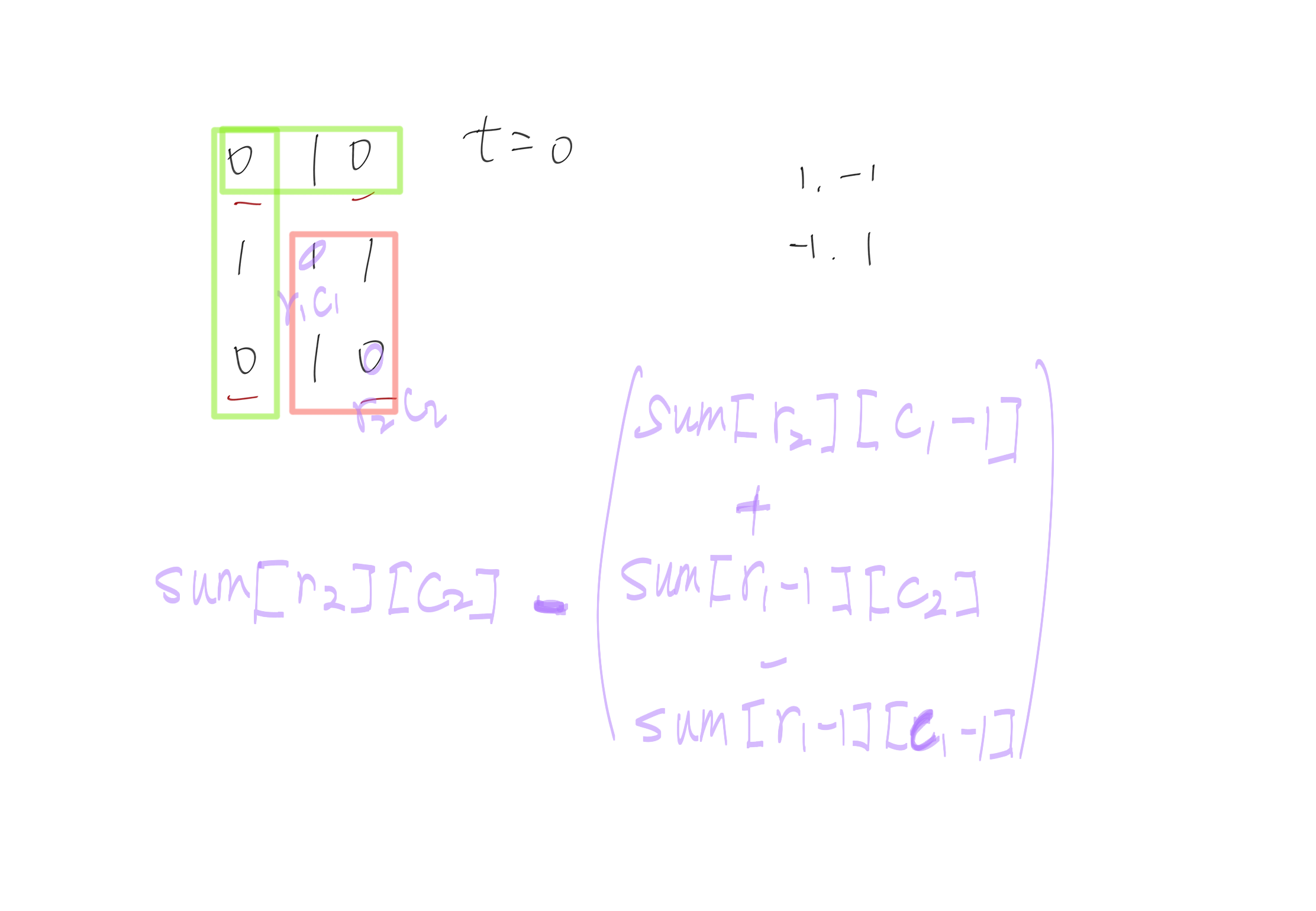
二维前缀和,思路参考下图:
class NumMatrix {
    int[][] presum;

    public NumMatrix(int[][] matrix) {
        int[][] ma = matrix;
        int n = matrix.length;
        int m = matrix[0].length;
        presum = new int[n+1][m+1];

        for (int r = 0; r < n; r++) {
            for (int c = 0; c < m; c++) {
                presum[r+1][c+1] = presum[r+1][c] + presum[r][c+1] - presum[r][c] + ma[r][c];
            }
        }
    }

    public int sumRegion(int row1, int col1, int row2, int col2) {
        return presum[row2+1][col2+1] - presum[row2+1][col1] - presum[row1][col2+1] + presum[row1][col1];
    }
}
# 338. 比特位计数
同:剑指 Offer II 003. 前 n 个数字二进制中 1 的个数
// [0 1 1 2 1 2]
// n&(n-1) 代表,如果偶数,能获得n-2的值,如果是奇数,获得n-1的值,如果是2的精确幂,则是0。
// n&(n-1) 会找出n是0还是2的精确幂。
public int[] countBits(int num) {
    int[] res = new int[num+1];
    for (int i = 1; i <= num; i++) {
        res[i] = res[i & (i - 1)] + 1;
    }
    return res;
}
动态规划,右移一位,获取之前计算的结果,然后加上右移移除的那一位数(可能0或1):
class Solution {
    public int[] countBits(int n) {
        int[] res = new int[n+1];
        int i = 0;
        while (i++ < n) {
            res[i] = res[i>>>1] + (i&1);
        }
        return res;
    }
}
与第一个解相同,一个月后再次写,这个解的规律不容易发现:
class Solution {
    public int[] countBits(int n) {
        int[] res = new int[n+1];
        int i = 0;
        while (i++ < n) {
            res[i] = res[i&(i-1)] + 1;
        }
        return res;
    }
}
一年后再写,虽然发现了规律,但是没有想到用位运算来解决。
class Solution {
    public int[] countBits(int n) {
        int[] res = new int[n+1];
        res[0] = 0;
        int next = 1;
        int i = 1;
        int add = 0;
        while (i <= n) {
            if (i == next) {
                add = 0;
                next = next * 2;
            }
            res[i] = 1 + res[add];
            add++
            i++;
        }
        return res;
    }
}
# 354. Russian Doll Envelopes(俄罗斯套娃信封问题)
// 宫水三叶 题解
class Solution {
    public int maxEnvelopes(int[][] es) {
        int n = es.length;
        if (n == 0) return n;
        // 由于我们使用了 g 记录高度,因此这里只需将 w 从小到达排序即可
        Arrays.sort(es, (a, b)->a[0] - b[0]);
        // f(i) 为考虑前 i 个物品,并以第 i 个物品为结尾的最大值
        int[] f = new int[n];
        // g(i) 记录的是长度为 i 的最长上升子序列的最小「信封高度」
        int[] g = new int[n];
        // 因为要取 min,用一个足够大(不可能)的高度初始化
        Arrays.fill(g, Integer.MAX_VALUE);
        g[0] = 0;
        int ans = 1;
        for (int i = 0, j = 0, len = 1; i < n; i++) {
            // 对于 w 相同的数据,不更新 g 数组,从而保证 g 中只会出现满足 w 严格小于当前信封的「历史信封」
            if (es[i][0] != es[j][0]) {
                // 限制 j 不能越过 i,确保 g 数组中只会出现第 i 个信封前的「历史信封」
                while (j < i) {
                    int prev = f[j], cur = es[j][1];
                    if (prev == len) {
                        // 与当前长度一致了,说明上升序列多增加一位
                        g[len++] = cur;
                    } else {
                        // 始终保留最小的「信封高度」,这样可以确保有更多的信封可以与其行程上升序列
                        // 举例:同样是上升长度为 5 的序列,保留最小高度为 5 记录(而不是保留任意的,比如 10),这样之后高度为 7 8 9 的信封都能形成序列;
                        g[prev] = Math.min(g[prev], cur);
                    }
                    j++;
                }
            }

            // 二分过程
            // g[i] 代表的是上升子序列长度为 i 的「最小信封高度」
            int l = 0, r = len;
            while (l < r) {
                int mid = l + r >> 1;
                // 令 check 条件为 es[i][1] <= g[mid](代表 w 和 h 都严格小于当前信封)
                // 这样我们找到的就是满足条件,最靠近数组中心点的数据(也就是满足 check 条件的最大下标)
                // 对应回 g[] 数组的含义,其实就是找到 w 和 h 都满足条件的最大上升长度
                if (es[i][1] <= g[mid]) {
                    r = mid;
                } else {
                    l = mid + 1;
                }
            }
            // 更新 f[i] 与答案
            f[i] = r;
            ans = Math.max(ans, f[i]);
        }
        return ans;
    }
}
# 739. 每日温度
@RunWith(Parameterized.class)
public class DailyTemperatures {
    @Parameters
    public static Iterable<Object[]> data() {
        return Arrays.asList(new Object[][]{
                {new int[]{73, 74, 75, 71, 69, 72, 76, 73}, new int[]{1, 1, 4, 2, 1, 1, 0, 0}},
                {new int[]{73}, new int[]{0}},
        });
    }

    @Parameter
    public int[] nums;

    @Parameter(1)
    public int[] expect;

    @Test
    public void test() {
        int[] result = dailyTemperatures(nums);
        Assert.assertArrayEquals(expect, result);
    }

    public int[] dailyTemperatures(int[] nums) {
        Stack<Integer> stack = new Stack<>();
        int n = nums.length;
        int[] res = new int[n];
        for (int i = 0; i < n; i++) {
            while (!stack.isEmpty() && nums[i] > nums[stack.peek()]) {
                int pop = stack.pop();
                res[pop] = i - pop;
            }
            stack.push(i);
        }
        return res;
    }

    // 数组替代单调栈的方法,数组更快,内存消耗更低。
    public int[] dailyTemperatures2(int[] nums) {
        int n = nums.length;
        int[] stack = new int[n];
        int pop = -1;
        int[] res = new int[n];
        for (int i = 0; i < n; i++) {
            while (pop >= 0 && nums[i] > nums[stack[pop]]) {
                int min = stack[pop--];
                res[min] = i - min;
            }
            stack[++pop] = i;
        }
        return res;
    }
}
重刷,使用单调栈,写法上还是复杂了
class Solution {
    public int[] dailyTemperatures(int[] temperatures) {
        // int[]{index, value}
        Stack<Integer> stack = new Stack<>();
        int[] res = new int[temperatures.length];
        for (int i = 0; i < temperatures.length; i++) {
            if (stack.empty() || temperatures[i] <= temperatures[stack.peek()]) {
                stack.push(i);
            } else {
                while (!stack.empty() && temperatures[i] > temperatures[stack.peek()]) {
                    int pop = stack.pop();
                    res[pop] = i-pop;
                }
                stack.push(i);
            }
        }
        return res;
    }
}
# 503. Next Greater Element II(下一个更大元素 II)
@RunWith(Parameterized.class)
public class NextGreaterElementII {
    @Parameters
    public static Iterable<Object[]> data() {
        return Arrays.asList(new Object[][]{
                {new int[]{1, 2, 1}, new int[]{2, -1, 2}},
                {new int[]{0}, new int[]{-1}},
        });
    }

    @Parameter
    public int[] nums;

    @Parameter(1)
    public int[] expect;

    @Test
    public void test() {
        int[] result = nextGreaterElements(nums);
        Assert.assertArrayEquals(expect, result);
    }

    public int[] nextGreaterElements(int[] nums) {
        int n = nums.length;
        int[] stack = new int[n];
        int pop = -1;
        int[] res = new int[n];
        Arrays.fill(res, -1);
        for (int i = 0, j = 0; i < n * 2; i++, j = i % n) {
            while (pop >= 0 && nums[j] > nums[stack[pop]]) {
                int min = stack[pop--];
                res[min] = nums[j];
            }
            if (res[j] <= 0 && pop + 1 < n) {
                stack[++pop] = j;
            }
        }
        return res;
    }
}
# 232. Implement Queue using Stacks(用栈实现队列)
@RunWith(Parameterized.class)
public class ImplementQueueUsingStacks {
    @Parameters
    public static Iterable<Object[]> data() {
        return Arrays.asList(new Object[][]{
                {1,2},
        });
    }

    @Parameter
    public int a;

    @Parameter(1)
    public int b;

    @Test
    public void test() {
        MyQueue q = new MyQueue();
        q.push(a);
        Assert.assertEquals(a, q.peek());
        q.push(b);
        Assert.assertEquals(a, q.peek());
        Assert.assertEquals(a, q.pop());
        Assert.assertEquals(b, q.pop());
        Assert.assertTrue(q.empty());
    }

    class MyQueue {
        Stack<Integer> in = new Stack<>();
        Stack<Integer> out = new Stack<>();
        /** Initialize your data structure here. */
        public MyQueue() {

        }

        /** Push element x to the back of queue. */
        public void push(int x) {
            in.push(x);
        }

        /** Removes the element from in front of queue and returns that element. */
        public int pop() {
            dao();
            return out.pop();
        }

        /** Get the front element. */
        public int peek() {
            dao();
            return out.peek();
        }

        /** Returns whether the queue is empty. */
        public boolean empty() {
            return out.empty()&&in.empty();
        }

        public void dao(){
            if(out.isEmpty()){
                while (!in.isEmpty()) {
                    out.push(in.pop());
                }
            }
        }
    }
}
# 125. Valid Palindrome(验证回文串)
@RunWith(Parameterized.class)
public class ValidPalindrome {
    @Parameters
    public static Iterable<Object[]> data() {
        return Arrays.asList(new Object[][]{
                {"A man, a plan, a canal: Panama", true},
        });
    }

    @Parameter
    public String s;

    @Parameter(1)
    public boolean expect;

    @Test
    public void test() {
        boolean result = isPalindrome(s);
        Assert.assertEquals(expect, result);
    }

    public boolean isPalindrome(String s) {
        // 只保留字母和数字
        s = keepNumberAndAlphabet(s);
        // 翻转过来
        String r = reverse(s);
        // 与原字符串比较
        return r.equalsIgnoreCase(s);
    }

    private String reverse(String s) {
        return new StringBuffer(s).reverse().toString();
    }

    private String keepNumberAndAlphabet(String s) {
        return s.replaceAll("[^a-zA-Z0-9]", "");
    }
}
# 189. 旋转数组
暴力法,On空间复杂度:
class Solution {
    public void rotate(int[] nums, int k) {
        int n = nums.length;
        int[] res = new int[n];
        for (int i = 0; i < n; i++) {
            res[i] = nums[i];
        }
        for (int i = 0; i < n; i++) {
            nums[(i+k)%n] = res[i];
        }
    }
}
环状替换,没太看懂 - -:
// TODO
多次翻转链表,O1的空间复杂度:
class Solution {
    public void rotate(int[] nums, int k) {
        int n = nums.length;
        k = k % n;
        reverse(nums, 0, n-1);
        reverse(nums, 0, k-1);
        reverse(nums, k, n-1);
    }

    private void reverse(int[] nums, int start, int end) {
        while (start < end) {
            int tmp = nums[start];
            nums[start] = nums[end];
            nums[end] = tmp;
            start++;
            end--;
        }
    }
}
# 122. Best Time to Buy and Sell Stock II(买卖股票的最佳时机 II)
class Solution {
    public int maxProfit(int[] p) {
        int n = p.length;
        int res = 0;
        for (int i = 1; i < n; i++) {
            res += Math.max(0, p[i] - p[i-1]);
        }
        return res;
    }
}
一个月后再来做,提交的代码如下,代码存在重复逻辑,不清晰,可以简化成上面的标准答案。
// 本题求上升数字中的差值,累加差值即可。
class Solution {
    public int maxProfit(int[] p) {
        int n = p.length;
        int max = 0;
        int pre = p[0];
        for (int i = 1; i < n; i++) {
            if (p[i] <= pre) {
                pre = p[i];
            } else if (p[i] > pre) {
                max += p[i]-pre;
                pre = p[i];
            }
        }
        return max;
    }
}
简化后,基本和第一版题解一致了: 本来就只是用前一个值,直接下标减一即可,为啥还要单独用变量存起来,傻子阿
class Solution {
    public int maxProfit(int[] p) {
        int max = 0;
        for (int i = 1; i < p.length; i++) {
            if (p[i] > p[i-1]) {
                max += p[i] - p[i-1];
            }
        }
        return max;
    }
}
# 217. Contains Duplicate(存在重复元素)
// 1.set judge duplicate
class Solution {
    public boolean containsDuplicate(int[] nums) {
        Set<Integer> set = new HashSet<>();
        int n = nums.length;
        for (int i = 0; i< n; i++) {
            if (set.contains(nums[i])) {
                return true;
            } else {
                set.add(nums[i]);
            }
        }
        return false;
    }
}
# 136. Single Number(只出现一次的数字)
class Solution {
    public int singleNumber(int[] nums) {
        int n = nums.length;
        int res = 0;
        for (int i = 0; i < n; i++) {
            res ^= nums[i];
        }
        return res;
    }
}
# 350. Intersection of Two Arrays II(两个数组的交集 II)
@RunWith(Parameterized.class)
public class IntersectionOfTwoArraysII {
    @Parameters
    public static Iterable<Object[]> data() {
        return Arrays.asList(new Object[][]{
                {new int[]{1, 2, 2, 1}, new int[]{2, 2}, new int[]{2, 2}},
        });
    }

    @Parameter
    public int[] nums1;

    @Parameter(1)
    public int[] nums2;

    @Parameter(2)
    public int[] expect;

    @Test
    public void test() {
        int[] result = intersect(nums1, nums2);
        Assert.assertArrayEquals(expect, result);
    }

    public int[] intersect(int[] nums1, int[] nums2) {
        int n = nums1.length;
        int m = nums2.length;
        Map<Integer, Integer> map = new HashMap<>();
        for (int i = 0; i < n; i++) {
            Integer tmp = map.get(nums1[i]);
            if (tmp == null) {
                map.put(nums1[i], 1);
            } else {
                map.put(nums1[i], tmp + 1);
            }
        }
        int[] res = new int[n];
        int index = 0;
        for (int i = 0; i < m; i++) {
            Integer tmp = map.get(nums2[i]);
            if (tmp != null && tmp != 0) {
                res[index++] = nums2[i];
                map.put(nums2[i], tmp - 1);
            }
        }
        return Arrays.copyOfRange(res, 0, index);
    }
}
# 66. 加一
public int[] plusOne(int[] d) {
    int n = d.length;
    int up = 1;
    for (int i = n-1; i > -1; i--) {
        int tmp = d[i] + up;
        if (tmp >= 10) {
            up = 1;
        } else {
            up = 0;
        }
        d[i] = tmp % 10;
    }
    if (up > 0) {
        int[] res = new int[n+1];
        res[0] = 1;
        System.arraycopy(d, 0, res, 1, n);
        return res;
    }
    return d;
}
func plusOne(digits []int) []int {
    n := len(digits)
    d := digits[0:n]
    plus := 1
    for i := n-1; i >= 0; i-- {
        d[i] = d[i] +  plus
        if d[i] > 9 {
            plus = 1
            d[i] = 0
        } else {
            plus = 0
            break
        }
    }
    if plus == 1 {
        d[0] = 0
        d = append([]int{1}, d...)
    }
    return d
}
# 283. Move Zeroes(移动零)
class Solution {
    public void moveZeroes(int[] nums) {
        int n = nums.length;
        int idx = 0;
        for (int i = 0; i < n; i++) {
            if (nums[i] != 0) {
                swap(nums, i, idx);
                idx++;
            }
        }
    }

    private void swap(int[] nums, int a, int b) {
        int tmp = nums[a];
        nums[a] = nums[b];
        nums[b] = tmp;
    }
}
go解法,朴素思路,利用两个指针,当外层循环遍历到0时,就起一个新的指针+1开始往后内循环,找到第一个不等于0的数,与外循环指针进行交换,随后break内循环,从外循环继续:
func moveZeroes(nums []int)  {
    n := len(nums)
    for i, val := range nums {
        if val == 0 {
            for j := i+1; j < n; j++ {
                if nums[j] != 0 {
                    swap(nums, i, j)
                    break
                }
            }
        }
    }
}

func swap(nums []int, a, b int) {
    nums[a], nums[b] = nums[b], nums[a]
}
两遍循环,利用双指针,第一个指针指向0的位置,第二个指针一致向后移动,如果遇见不等于0的数组,将非0的数交换到0上:
func moveZeroes(nums []int)  {
    j := 0
    for i, val := range nums {
        if val != 0 {
            nums[j] = nums[i]
            j++
        }
    }

    for j < len(nums) {
        nums[j] = 0
        j++
    }
}
也可以遍历数组, 遇到0时,将0删掉,追加到数组最后:
func moveZeroes(nums []int)  {
    n := len(nums)
    zcnt := 1
    for i := 0; i < n-zcnt; i++ {
        if nums[i] == 0 {
            nums = append(nums[:i], nums[i+1:]...)
            nums = append(nums, 0)
            i--
            zcnt++
        }
    }
}
# 70. Climbing Stairs(爬楼梯)
// f(n) = f(n-1) + f(n-2)
class Solution {
    public int climbStairs(int n) {
        if(n<3) return n;

        int a = 1, b = 2;
        int c = 0;
        for (int i = 2; i < n; i++) {
            c = a + b;
            a = b;
            b = c;
        }
        return c;
    }
}
# 28. Implement strStr() (实现 strStr())
class Solution {
    // 最快解上优化代码结构 @jesse
    public int strStr(String haystack, String needle) {
        if (needle.length() == 0) {
            return 0;
        }
        if (!haystack.contains(needle)) {
            return -1;
        }
        int i, count = 0;
        for (int v = 0; v < haystack.length(); v++) {
            i = v;
            int j = 0;
            for (; j < needle.length(); j++) {
                if (needle.charAt(j) == haystack.charAt(i)) {
                    count++;
                    i++;
                } else {
                    count = 0;
                    break;
                }
            }
            if (j == needle.length()) {
                if (count == needle.length()) {
                    return v;
                } else {
                    return -1;
                }
            }

        }
        return -1;
    }

    // 最快解
    public int strStr4(String haystack, String needle) {
        if (needle.length() == 0) {
            return 0;
        }
        if (!haystack.contains(needle)) {
            return -1;
        }
        int i = 0, count = 0;
        for (int v = 0; v < haystack.length(); v++) {
            for (int j = v; j < haystack.length(); j++) {
                if (needle.charAt(i) == haystack.charAt(j)) {
                    count++;
                    i++;
                } else {
                    count = 0;
                    i = 0;
                    break;
                }
                if (count == needle.length()) {
                    return (j-(needle.length()-1));
                }
            }
        }
        return -1;
    }

    // 最优雅
    public int strStr3(String haystack, String needle) {
        for (int i = 0; ; i++) {
            for (int j = 0; ; j++) {
              if (j == needle.length()) return i;
              if (i + j == haystack.length()) return -1;
              if (needle.charAt(j) != haystack.charAt(i + j)) break;
            }
        }
    }

    // violent @jesse
    // 很慢,for循环上使用了&&条件相比其他解会慢太多
    public int strStr2(String a, String b) {
        // b in a
        char[] ac = a.toCharArray();
        char[] bc = b.toCharArray();
        int al = ac.length;
        int bl = bc.length;
        if (bl == 0) {
            return bl;
        }
        if (bl > al) {
            return -1;
        }
        for (int i = 0; i < al; i++) {
            boolean match = true;
            int j = 0, itemp = i;
            for (; j < bl && itemp < al; j++, itemp++) {
                if (ac[itemp] != bc[j]) {
                    match = false;
                    break;
                }
            }
            if (j != bl) {
                match = false;
            }
            if (match) {
                return i;
            }
        }
        return -1;
    }
}
一个月后再刷:
class Solution {
    public int strStr(String h, String n) {
        // n is null or ""
        if (n == null || "".equals(n)) {
            return 0;
        }

        // 滑动窗口
        int len = h.length();
        int l = 0, r = n.length();
        while (r <= len) {
            if (h.substring(l, r).equals(n)) {
                return l;
            }
            l++;
            r++;
        }
        return -1;
    }
}
# 38. Count and Say(外观数列)
class Solution {
    // for循环解决
    public String countAndSay(int n) {
        StringBuilder sb = new StringBuilder("1");
         for (int i = 1; i < n; i++) {
            sb = recursive(sb);
        }
        return sb.toString();
    }

    private StringBuilder recursive(StringBuilder sb) {
        StringBuilder nsb = new StringBuilder();
        char pre = sb.charAt(0);
        int cnt = 1;
        for (int i = 1; i < sb.length(); i++) {
            if (sb.charAt(i) == pre) {
                cnt++;
            } else {
                // current -> pre
                // concat string
                nsb.append(cnt);
                nsb.append(pre);

                pre = sb.charAt(i);
                cnt = 1;
            }
        }
        nsb.append(cnt);
        nsb.append(pre);
        return nsb;
    }
}
# 344. Reverse String(反转字符串)
class Solution {
    public void reverseString(char[] s) {
        int n = s.length;
        int l = 0, r = n - 1;
        while (l < r) {
            swap(s, l, r);
            l++;
            r--;
        }
    }

    private void swap(char[] s, int l, int r) {
        char t = s[l];
        s[l] = s[r];
        s[r] = t;
    }
}
# 387. First Unique Character in a String(字符串中的第一个唯一字符)
class Solution {
    public int firstUniqChar(String s) {
        int[] set = new int[26];
        char[] c = s.toCharArray();
        int n = c.length;
        for (int i = 0; i < n; i++) {
            set[c[i] - 'a']++;
        }
        for (int i = 0; i < n; i++) {
            if (set[c[i] - 'a'] == 1) {
                return i;
            }
        }
        return -1;
    }
}
# 14. Longest Common Prefix(最长公共前缀)
class Solution {
    public String longestCommonPrefix(String[] s) {
        int n = s.length;
        if (n == 0) {
            return "";
        }
        String comm = s[0];
        for (int i = 1; i < n; i++) {
            comm = longestCommonPrefix(comm, s[i]);
        }
        return comm;
    }

    private String longestCommonPrefix(String a, String b) {
        int n = Math.min(a.length(), b.length());
        String comm = "";
        int index = -1;
        for (int i = 0; i < n; i++) {
            if (a.charAt(i) != b.charAt(i)) {
                break;
            }
            index++;
        }
        if (index > -1) {
            comm = a.substring(0, index + 1);
        }
        return comm;
    }
}
# 1047. Remove All Adjacent Duplicates In String(删除字符串中的所有相邻重复项)
class Solution {
    public String removeDuplicates(String s) {
        Stack<Character> stack = new Stack<>();
        for (int i = 0; i < s.length(); i++) {
            if (!stack.empty() && stack.peek().equals(s.charAt(i))) {
                stack.pop();
            } else {
                stack.push(s.charAt(i));
            }
        }
        StringBuilder sb = new StringBuilder();
        while (!stack.empty()) {
            sb.append(stack.pop());
        }
        return sb.reverse().toString();
    }
}
# 206. Reverse Linked List(反转链表)
class Solution {
    // @jesse
    public ListNode reverseList(ListNode head) {
        // 1->2->3
        ListNode tail = null;
        if (head == null) {
            return head;
        }
        while (head.next != null) {
            ListNode tmp = head;
            head = head.next;
            tmp.next = tail;
            tail = tmp;
        }
        head.next = tail;
        return head;
    }
}
时隔4个月后再做,写法更简洁了:
class Solution {
    public ListNode reverseList(ListNode head) {
        ListNode pre = null;
        ListNode cur = head;
        while (cur!=null) {
            ListNode next = cur.next;
            cur.next = pre;
            pre = cur;
            cur = next;
        }
        return pre;
    }
}
# 234. Palindrome Linked List(回文链表)
class Solution {
    // [1,1,2,1]
    // [1,2,2,1]
    // [1,2,3,2,1]
    // [2,2,2]
    // [2,2,2,2]
    // [3,2,3,1]
    // [1]
    // [1,2]
    // [2,2]
    public boolean isPalindrome2(ListNode head) {
        // reverse half list, two points(fast&slow)
        ListNode fast = head, slow = head;
        while (fast != null && fast.next != null) {
            slow = slow.next;
            fast = fast.next.next;
        }
        // 奇偶数节点处理
        if (fast != null) {
            slow = slow.next;
        }
        ListNode tail = reverse(slow);
        while (tail != null) {
            if (head.val != tail.val) {
                return false;
            }
            head = head.next;
            tail = tail.next;
        }
        return true;
    }

    public ListNode reverse(ListNode head) {
        ListNode tail = null;
        if (head == null) {
            return null;
        }
        while (head.next != null) {
            ListNode tmp = head;
            head = head.next;
            tmp.next = tail;
            tail = tmp;
        }
        head.next = tail;
        return head;
    }

    public ListNode front;
    // @题解 递归
    public boolean isPalindrome(ListNode head) {
        // 利用递归
        front = head;
        return recursive(head);
    }

    private boolean recursive(ListNode node) {
        // recursive term condition
        if (node == null) {
            return true;
        }
        // compare
        boolean res = (recursive(node.next) && front.val == node.val);
        // two point go next
        front = front.next;
        return res;
    }
}
# 237. 删除链表中的节点
//sb?
class Solution {
    public void deleteNode(ListNode node) {
        node.val = node.next.val;
        node.next = node.next.next;
    }
}
# 21. Merge Two Sorted Lists(合并两个有序链表)
class Solution {
    public ListNode mergeTwoLists(ListNode a, ListNode b) {
        ListNode head = new ListNode(0);
        ListNode node = head;
        while (a != null && b != null) {
            if (a.val <= b.val) {
                node.next = a;
                a = a.next;
            } else {
                node.next = b;
                b = b.next;
            }
            node = node.next;
        }

        while (a != null) {
            node.next = a;
            a = a.next;
            node = node.next;
        }

        while (b != null) {
            node.next = b;
            b = b.next;
            node = node.next;
        }
        return head.next;
    }
}
func mergeTwoLists(l1 *ListNode, l2 *ListNode) *ListNode {
    head := new(ListNode)
    var res *ListNode = head
    for l1 != nil && l2 != nil {
        if l1.Val < l2.Val {
            res.Next = l1
            l1 = l1.Next
            res = res.Next
        } else {
            res.Next = l2
            l2 = l2.Next
            res = res.Next
        }
    }

    var l3 *ListNode
    if l1 != nil {
        l3 = l1
    }
    if l2 != nil {
        l3 = l2
    }

    for l3 != nil {
        res.Next = l3
        l3 = l3.Next
        res = res.Next
    }

    return head.Next
}
# 141. Linked List Cycle(环形链表)
public class Solution {
    public boolean hasCycle(ListNode head) {
        ListNode fast = head;
        ListNode slow = head;
        while (slow != null && fast != null && fast.next != null) {
            slow = slow.next;
            fast = fast.next.next;
            if (slow == fast) {
                return true;
            }
        }
        return false;
    }
}
# 88. 合并两个有序数组
// nums1 = [1,2,3,0,0,0], m = 3, nums2 = [2,5,6], n = 3
// nums1 = [1,2,0,0,0], m = 2, nums2 = [2,5,6], n = 3
// nums1 = [1,2,3,4,0,0,0], m = 4, nums2 = [2,5,6], n = 3
// nums1 = [1,3,7,0,0,0], m = 3, nums2 = [2,5,6], n = 3
// nums1 = [1], m = 1, nums2 = [], n = 0
class Solution {
    public void merge(int[] n1, int m, int[] n2, int n) {
        if (n == 0) {
            return;
        }
        int a = 0;
        while (a < m) {
            if (n1[a] <= n2[0]) {
                a++;
            } else {
                swap(n1, a, n2, 0);
            }
        }
        for (int i = 0; i < n; i++) {
            swap2(n1, m + i, n2, i);
        }
    }

    private void swap(int[] n1, int a, int[] n2, int b) {
        int tmp = n1[a];
        n1[a] = n2[b];
        n2[b] = tmp;
        for (int i = 1; i < n2.length; i++) {
            if (n2[i - 1] > n2[i]) {
                swap(n2, i - 1, i);
            } else {
                break;
            }
        }
    }

    private void swap2(int[] n1, int a, int[] n2, int b) {
        int tmp = n1[a];
        n1[a] = n2[b];
        n2[b] = tmp;
    }

    private void swap(int[] nums, int a, int b) {
        int tmp = nums[a];
        nums[a] = nums[b];
        nums[b] = tmp;
    }
}
go解法:
func merge(nums1 []int, m int, nums2 []int, n int)  {
    n1, n2 := nums1, nums2
    if n <= 0 {
        return
    }
    i := 0
    for j := 0; i < m; {
        if n1[i] <= n2[j] {
            i++
        } else {
            n1[i], n2[j] = n2[j], n1[i]
            for k := j+1; k < n; k++ {
                if n2[k] < n2[k-1] {
                    n2[k], n2[k-1] = n2[k-1], n2[k]
                } else {
                    break
                }
            }
        }
    }

    for j := 0 ; i < m+n; i++ {
        n1[i], n2[j] = n2[j], n1[i]
        j++
    }
}
# 278. First Bad Version(第一个错误的版本)
常规做法是通过二分法找到第一个错误的版本,另一种是找到最后一个正确的版本,那错误版本就是再+1即可。
public class Solution extends VersionControl {
    // 二分查找
    public int firstBadVersion(int n) {
        int left = 1, mid = 0, right = n;
        while (left < right) {
            mid = left + (right - left) / 2;
            if (isBadVersion(mid)) {
                right = mid;
            } else {
                left = mid + 1;
            }
        }
        return left;
    }
}
二分法,go:
func firstBadVersion(n int) int {
    l, r := 1, n
    for l < r {
        mid := l + ((r-l)>>1)
        if isBadVersion(mid) {
            r = mid
        } else {
            l = mid + 1
        }
    }
    return r
}
找到最后一个正确的版本:
func firstBadVersion(n int) int {
    // left从0开始,为了兼容n=1的场景,否则无法进入while循环
    l, r := 0, n
    for l < r {
        mid := l + ((r-l+1)>>1)
        if isBadVersion(mid) {
            r = mid-1
        } else {
            l = mid
        }
    }
    return l+1
}
当使用while (l <= r)时:
func firstBadVersion(n int) int {
    l, r := 1, n
    for l <= r {
        mid := l + ((r-l)>>1)
        if isBadVersion(mid) {
            r = mid-1
        } else {
            l = mid+1
        }
    }
    return r+1
}
当使用while (l <= r),且mid落点偏右(偏右是寻找最后一个正确版本)时:
func firstBadVersion(n int) int {
    l, r := 0, n
    for l <= r {
        mid := l + ((r-l+1)>>1)
        if isBadVersion(mid) {
            r = mid-1
        } else {
            l = mid+1
        }
    }
    return l
}
# 98. Validate Binary Search Tree
class Solution {
    // 栈 题解
    public boolean isValidBST(TreeNode root) {
        if (root == null) return true;
        Stack<TreeNode> stack = new Stack<>();
        TreeNode pre = null;
        while (root != null || !stack.isEmpty()) {
            while (root != null) {
                stack.push(root);
                root = root.left;
            }
            root = stack.pop();
            if(pre != null && root.val <= pre.val) return false;
            pre = root;
            root = root.right;
        }
        return true;
    }

    // 递归 题解
    public boolean isValidBST2(TreeNode root) {
        return recursive(root, Long.MIN_VALUE, Long.MAX_VALUE);
    }

    private boolean recursive(TreeNode node, long left, long right) {
        if (node == null) {
            return true;
        }
        if (node.val <= left || node.val >= right) {
            return false;
        }
        return recursive(node.left, left, node.val) && recursive(node.right, node.val, right);
    }
}
# 104. Maximum Depth of Binary Tree
class Solution {
    int max = 0;
    public int maxDepth(TreeNode root) {
        recursive(root, 0);
        return max;
    }
    // d: pre depth
    private void recursive(TreeNode n, int d) {
        if (n == null) {
            max = Math.max(max, d);
            return;
        }
        recursive(n.left, d+1);
        recursive(n.right, d+1);
    }
}
# 101. 对称二叉树
class Solution {
    public boolean isSymmetric(TreeNode root) {
        return recursive(root, root);
    }

    private boolean recursive(TreeNode a, TreeNode b) {
        if (a == null && b == null) {
            return true;
        }
        if (a != null && b != null) {
            if (a.val == b.val && recursive(a.left, b.right) && recursive(a.right, b.left)) {
                return true;
            }
        }
        return false;
    }
}
模拟,go解法:
func isSymmetric(root *TreeNode) bool {
	return root == nil || recursive(root.Left, root.Right)
}

func recursive(l, r *TreeNode) bool {
	if l == nil && r == nil {
		return true
	}
	if l == nil || r == nil || l.Val != r.Val {
		return false
	}

	return recursive(l.Left, r.Right) && recursive(r.Left, l.Right)
}
# 102. Binary Tree Level Order Traversal
class Solution {
    List<List<Integer>> res = new ArrayList<>();
    public List<List<Integer>> levelOrder(TreeNode root) {
        recursive(root, 0);
        return res;
    }

    private void recursive(TreeNode n, int row) {
        if (n == null) {
            return;
        }
        List<Integer> data;
        if (res.size() <= row) {
            data = new ArrayList<>();
            res.add(data);
        } else {
            data = res.get(row);
        }
        data.add(n.val);

        recursive(n.left, row+1);
        recursive(n.right, row+1);
    }
}
# 191. 位1的个数
就是求汉明重量:
public class Solution {
    // you need to treat n as an unsigned value
    public int hammingWeight(int i) {
        i = (i & 0x55555555) + ((i >> 1) & 0x55555555);
        i = (i & 0x33333333) + ((i >> 2) & 0x33333333);
        i = (i & 0x0F0F0F0F) + ((i >> 4) & 0x0F0F0F0F);
        i = (i * (0x01010101) >> 24);
        return i;
    }
}
# 108. Convert Sorted Array to Binary Search Tree(将有序数组转换为二叉搜索树)
class Solution {
    public TreeNode sortedArrayToBST(int[] nums) {
        return recursive(nums, 0, nums.length-1);
    }

    private TreeNode recursive(int[] nums, int l, int r) {
        if (l > r) {
            return null;
        }
        int mid = (l + r) / 2;
        TreeNode n = new TreeNode(nums[mid]);
        n.left = recursive(nums, l, mid-1);
        n.right = recursive(nums, mid+1, r);
        return n;
    }
}
# 169. Majority Element
class Solution {
    public int majorityElement(int[] nums) {
        Arrays.sort(nums);
        if (nums[0] == nums[(nums.length/2)]) {
            return nums[0];
        } else {
            return nums[(nums.length/2)];
        }
    }
}
# 331. Verify Preorder Serialization of a Binary Tree
class Solution {
    private char j = '#';
    private char d = ',';
    public boolean isValidSerialization(String p) {
        // 计数
        int cnt = 1;
        int n = p.length();
        for (int i = 0; i < n; i++) {
            if (cnt == 0) return false; // 表示树结构完整,但数组里面还有节点,因此false
            char c = p.charAt(i);
            if (d == c) continue;
            else if (j == c) cnt--;
            else {
                while (i+1 < n && d != p.charAt(i+1)) {
                    i++;
                }
                cnt++;
            }
        }
        return cnt == 0;
    }
}
# 190. Reverse Bits
public class Solution {
    // you need treat n as an unsigned value
    public int reverseBits2(int n) {
        int res = 0;
        for (int i = 0; i < 32; i++) {
            int b = n & 1;
            n = n >>> 1;
            res = (res << 1) | b; // 用或|和异或^都可以
        }
        return res;
    }
    // O(1) java.lang.Integer.reverse()方法jdk8的实现
    public int reverseBits(int i) {
        i = (i & 0x55555555) << 1 | (i >>> 1) & 0x55555555;
        i = (i & 0x33333333) << 2 | (i >>> 2) & 0x33333333;
        i = (i & 0x0f0f0f0f) << 4 | (i >>> 4) & 0x0f0f0f0f;
        i = (i << 24) | ((i & 0xff00) << 8) |
            ((i >>> 8) & 0xff00) | (i >>> 24);
        return i;
    }
}
# 268. 丢失的数字
class Solution {
    public int missingNumber(int[] nums) {
        int n = nums.length, res = 0;
        for (int i = 0; i < n; i++) {
            res ^= nums[i];
            res ^= i+1;
        }
        return res;
    }
}
# 20. Valid Parentheses
class Solution {
    Map<Character, Character> map = new HashMap<>();
    {
        map.put('{', '}');
        map.put('[', ']');
        map.put('(', ')');
    }
    public boolean isValid(String s) {
        Stack<Character> z = new Stack<>();
        int n = s.length();
        for (int i = 0; i < n; i++) {
            char c = s.charAt(i);
            if (z.empty()) {
                z.push(c);
            } else {
                Character tmp = map.get(z.peek());
                if (tmp != null && tmp == c) {
                    z.pop();
                } else {
                    z.push(c);
                }
            }
        }
        return z.empty();
    }
}
# 118. 杨辉三角
class Solution {
    // 暴力
    public List<List<Integer>> generate(int n) {
        List<List<Integer>> res = new ArrayList<>();
        // row
        for (int i = 0; i < n; i++) {
            // every row
            List<Integer> r = new ArrayList<>();
            r.add(1);
            for (int j = 1; j < i; j++) {
                // f(row, col) = f(row-1, col-1) + f(row-1, col)
                r.add(res.get(i-1).get(j-1) + res.get(i-1).get(j));
            }
            r.add(1);
            res.add(r);
        }
        res.get(0).remove(1);
        return res;
    }
}
重刷,思路简单清晰了很多
class Solution {
    public List<List<Integer>> generate(int numRows) {
        List<List<Integer>> res = new ArrayList<>();
        for (int i = 0; i < numRows; i++) {
            List<Integer> row = new ArrayList<>();
            List<Integer> pre = null;
            if (i > 0) pre = res.get(i-1);
            for (int j = 0; j <= i; j++) {
                if (j == 0) {
                    row.add(1);
                } else if (j == i) {
                    row.add(1);
                } else {
                    row.add(pre.get(j-1)+pre.get(j));
                }
            }
            res.add(row);
        }
        return res;
    }
}
# 461. Hamming Distance(汉明距离)
class Solution {
    public int hammingDistance(int x, int y) {
        int i = x ^ y;
        return hammingWeight(i);
    }
    // 利用汉明重量求1的个数
    public int hammingWeight(int i) {
        i = (i & 0x55555555) + ((i >> 1) & 0x55555555);
        i = (i & 0x33333333) + ((i >> 2) & 0x33333333);
        i = (i & 0x0F0F0F0F) + ((i >> 4) & 0x0F0F0F0F);
        i = (i * (0x01010101) >> 24);
        return i;
    }
}
使用n&(n-1)来快速消除下一个1:
class Solution {
    public int hammingDistance(int x, int y) {
        int diff = x ^ y;
        int cnt = 0;
        while (diff != 0) {
            diff &= diff - 1;
            cnt++;
        }
        return cnt;
    }
}
# 412. Fizz Buzz
class Solution {
    // 暴力法
    public List<String> fizzBuzz(int n) {
        List<String> res = new ArrayList<>();
        for (int i = 1; i <= n; i++) {
            if (i % 3 == 0) {
                if (i % 5 == 0) {
                    res.add("FizzBuzz");
                    continue;
                }
                res.add("Fizz");
            } else if (i % 5 == 0) {
                res.add("Buzz");
            } else {
                res.add(String.valueOf(i));
            }
        }
        return res;
    }
}
# 326. 3的幂
class Solution {
    // Integer.MAX_VALUE = 2^32/2 - 1 = 2147483647
    // 3⌊log3MaxInt⌋=3⌊19.56⌋=3^19=1162261467
    public boolean isPowerOfThree(int n) {
        return n > 0 && 1162261467 % n == 0;
    }
}
试除法:
class Solution {
    public boolean isPowerOfThree(int n) {
        while (n > 1 && n % 3 == 0) {
            n /= 3;
        }
        return n == 1;
    }
}
# 204. Count Primes(计数质数)
class Solution {
    public int countPrimes(int n) {
        int cnt = 0;
        for (int i = 2; i < n; i++) {
            if (isPrime(i)) {
                cnt++;
            }
        }
        return cnt;
    }

    public static boolean isPrime(int num) {
        if (num <= 3) {
            return num > 1;
        }
        // 不在6的倍数两侧的一定不是质数
        if (num % 6 != 1 && num % 6 != 5) {
            return false;
        }
        int sqrt = (int) Math.sqrt(num);
        for (int i = 5; i <= sqrt; i += 6) {
            if (num % i == 0 || num % (i + 2) == 0) {
                return false;
            }
        }
        return true;
    }
}
# 705. Design HashSet(设计哈希集合)
class MyHashSet {
    /** Initialize your data structure here. */
    int base = 769;
    LinkedList[] data;
    private int hash(int k) {
        return k % base;
    }

    public MyHashSet() {
        data = new LinkedList[base];
    }

    public void add(int key) {
        LinkedList list = data[hash(key)];
        if (list == null) {
            list = new LinkedList<Integer>();
            data[hash(key)] = list;
        }
        list.add(key);
    }

    public void remove(int key) {
        LinkedList list = data[hash(key)];
        if (list == null) {
            return;
        }
        while (list.indexOf(key) != -1) {
            list.remove(list.indexOf(key));
        }
    }

    /** Returns true if this set contains the specified element */
    public boolean contains(int key) {
        LinkedList list = data[hash(key)];
        if (list == null) {
            return false;
        }
        return list.indexOf(key) != -1;
    }
}

/**
 * Your MyHashSet object will be instantiated and called as such:
 * MyHashSet obj = new MyHashSet();
 * obj.add(key);
 * obj.remove(key);
 * boolean param_3 = obj.contains(key);
 */
# 53. Maximum Subarray(最大子序和)
class Solution {
    // 利用额外变量来存储前一个最大值。最优解。
    public int maxSubArray(int[] nums) {
        int n = nums.length;
        int max = nums[0];
        int pre = nums[0];
        for (int i = 1; i < n; i++) {
            // pre = Math.max(pre+nums[i], nums[i]);
            if (pre > 0) {
                pre += nums[i];
            } else {
                pre = nums[i];
            }
            max = Math.max(pre, max);
        }
        return max;
    }

    // 利用数组本身存储值来递推,会修改原数组
    public int maxSubArray3(int[] nums) {
        int n = nums.length;
        int max = nums[0];
        for (int i = 1; i < n; i++) {
            if (nums[i-1] > 0) {
                nums[i] += nums[i-1];
            }
//            nums[i] = Math.max(nums[i-1]+nums[i], nums[i]);
            max = Math.max(nums[i], max);
        }
        return max;
    }

    // 朴素递归解法
    public int maxSubArray2(int[] nums) {
        // f(i) = max{f(i-1)+nums[i], nums[i]}
        int n = nums.length;
        int max = -999999;
        for (int i = 0; i < n; i++) {
            max = Math.max(recursive(nums, i), max);
        }
        return max;
    }

    private int recursive(int[] nums, int i) {
        if (i < 0) {
            return -999999;
        }
        return Math.max(recursive(nums, i-1)+nums[i], nums[i]);
    }
}
一个月后再做:
// 动归方程:dp[i]表示以nums[i]结尾的数,最大的子数组合。
// if dp[i-1] > 0, dp[i] = dp[i-1]+nums[i]
// if dp[i-1] <= 0, dp[i] = nums[i]
// 由于只依赖前一个最大子数组的合,所以可以进一步压缩空间,只用pre变量保存即可。
class Solution {
    public int maxSubArray(int[] nums) {
        int n = nums.length;
        // init
        int pre = nums[0];
        int max = nums[0];

        for (int i = 1; i < n; i++) {
            int tmp;
            if (pre > 0) {
                tmp = pre + nums[i];
            } else {
                tmp = nums[i];
            }
            max = Math.max(max, tmp);
            pre = tmp;
        }
        return max;
    }
}
# 121. 买卖股票的最佳时机
class Solution {
    public int maxProfit(int[] p) {
        int max = 0;
        int minI = 0;
        int n = p.length;
        for (int i = 1; i < n; i++) {
            // get minI & max
            if (p[i] < p[minI]) {
                minI = i;
            } else {
                max = Math.max(max, p[i] - p[minI]);
            }
        }
        return max;
    }
}
一个月后再做,变量定义混乱,逻辑冗余,代码需要再精简。
// 本题是求,小值在前,大值在后,两者最大差值。
// 解题方法:动归、单调栈
// diff[]: dp数组代表当天卖出的利润最大是多少,
// 动归方程:diff[i] = MAX{diff[i-1], curr-min} (curr > min)
class Solution {
    public int maxProfit(int[] p) {
        int n = p.length;
        int max = 0;
        int min = p[0];
        // 状态数组为差值集,记录当前值与最小值的差
        int[] diff = new int[n];
        diff[0] = 0;

        for (int i = 1; i < n; i++) {
            if (p[i] < min) {
                min = p[i];
                diff[i] = 0;
            } else if (p[i] > min) {
                diff[i] = Math.max(diff[i-1], p[i]-min);
                max = Math.max(max, diff[i]);
            } else {
                diff[i] = 0;
            }
        }
        return max;
    }
}
状态空间压缩后:
class Solution {
    public int maxProfit(int[] p) {
        int n = p.length;
        int max = 0;
        int min = p[0];
        // 状态压缩,不需使用dp数组,只依赖前一个状态,降低空间复杂度
        int diff = 0;
        for (int i = 1; i < n; i++) {
            if (p[i] < min) {
                min = p[i];
                diff = 0;
            } else if (p[i] > min) {
                diff = Math.max(diff, p[i]-min);
                max = Math.max(max, diff);
            } else {
                diff = 0;
            }
        }
        return max;
    }
}
暴力解法:会超时
class Solution {
    public int maxProfit(int[] prices) {
        int n = prices.length;
        int res = 0;
        for (int i = 0; i < n; i++) {
            for (int j = i+1; j < n; j++) {
                res = Math.max(res, prices[j]-prices[i]);
            }
        }
        return res;
    }
}
可以看出,要求出最大的利润,是由一个区间中的最大值-最小值(且最小值下标要小于最大值)获得的。因此可以通过一次遍历的过程,动态的更新最小值,一旦最小值更新,则废弃之前的最大值,重新在右边继续寻找最大值,每次找到一个最大值,则max-min去更新答案。
class Solution {
    public int maxProfit(int[] prices) {
        int n = prices.length;
        int res = 0;
        int min = prices[0];
        int max = prices[0];
        for (int i = 1; i < n; i++) {
            if (prices[i] < min) {
                min = prices[i];
                max = Integer.MIN_VALUE;
            } else {
                if (prices[i] > max) {
                    max = prices[i];
                    res = Math.max(res, max-min);
                }
            }
        }
        return res;
    }
}
# 198. 打家劫舍
class Solution {
    public int rob(int[] nums) {
        // f(i) = max{f(i-2) + nums[i], f(i-1)}
        if (nums.length == 0) {
            return 0;
        }
        if (nums.length == 1) {
            return nums[0];
        }
        if (nums.length == 2) {
            return Math.max(nums[0], nums[1]);
        }
        // f(i-2)
        int f2 = nums[0];
        // f(i-1)
        int f1 = Math.max(nums[0], nums[1]);
        // f(i)
        int f = 0;
        for (int i = 2; i < nums.length; i++) {
            f = Math.max(f2+nums[i], f1);
            f2 = f1;
            f1 = f;
        }
        return f;
    }
    // 递归 会超时
    public int rob2(int[] nums) {
        // f(i) = max{f(i-2) + nums[i], f(i-1)}
        return f(nums, nums.length - 1);
    }

    private int f(int[] nums, int i) {
        if (i > nums.length-1 || i < 0) {
            return 0;
        }
        if (i == 1) {
            return Math.max(nums[0], nums[1]);
        }
        if (i == 0) {
            return nums[0];
        }
        return Math.max(f(nums, i-2) + nums[i], f(nums, i-1));
    }
}
- 迭代(未压缩空间,使用原始大小dp数组空间)
// 动归方程:dp[i] = max(dp[i-1], dp[i-2]+Vi);
class Solution {
    public int rob(int[] nums) {
        // 边界场景
        int n = nums.length;
        if (n < 1) {
            return 0;
        } else if (n < 2) {
            return nums[0];
        } else if (n < 3) {
            return Math.max(nums[0], nums[1]);
        }
        // 初始化,dp0,dp1,属于迭代初始依赖数据
        int[] dp = new int[n];
        dp[0] = nums[0];
        dp[1] = Math.max(nums[0], nums[1]);

        // 迭代,从第三个房间开始,前两个已经初始化了
        for (int i = 2; i < n; i++) {
            dp[i] = Math.max(dp[i-1], dp[i-2]+nums[i]);
        }
        return dp[n-1];
    }
}
一个月后再做,直接使用最简动归,秒解:
class Solution {
    public int rob(int[] nums) {
        // f(n) = Math.max(f(n-1) , f(n-2) + val)
        int p1 = 0, p2 = nums[0];
        if (nums.length < 2) {
            return p2;
        }
        p1 = Math.max(p2, nums[1]);

        for (int i = 2 ; i < nums.length; i++) {
            int max = Math.max(p1, p2+nums[i]);
            p2 = p1;
            p1 = max;
        }

        return p1;
    }
}
几个月后再做,写法更简洁清晰了
class Solution {
    public int rob(int[] nums) {
        int n = nums.length;
        int i1 = 0, i2 = 0;
        for (int i = 0; i < n; i++) {
            int c = Math.max(i2+nums[i], i1);
            i2 = i1;
            i1 = c;
        }
        return i1;
    }
}
# 384. 打乱数组
class Solution {
    int[] nums;
    int[] origin;
    Random rand = new Random();
    public Solution(int[] nums) {
        this.nums = nums;
        this.origin = nums.clone();
    }

    /** Resets the array to its original configuration and return it. */
    public int[] reset() {
        return origin;
    }

    /** Returns a random shuffling of the array. */
    public int[] shuffle() {
        int n = nums.length;
        for (int i = 0; i < n; i++) {
            swap(nums, i, rand.nextInt(n-i)+i);
        }
        return nums;
    }

    private void swap(int[] n, int a, int b) {
        int t = n[a];
        n[a] = n[b];
        n[b] = t;
    }
}
一样的做法,稍微不同的代码写法而已:
class Solution {
    int[] nums;
    public Solution(int[] nums) {
        this.nums = nums;
    }

    public int[] reset() {
        return nums;
    }

    public int[] shuffle() {
        int[] res = nums.clone();
        for (int i = 0; i < nums.length; i++) {
            int j = (int) (Math.random() * (nums.length-i)) + i;
            swap(res, i, j);
        }
        return res;
    }

    private void swap(int[] ns, int i, int j) {
        int tmp = ns[i];
        ns[i] = ns[j];
        ns[j] = tmp;
    }
}
# 155. Min Stack(最小栈)
// todo 待实现,使用差值,不用额外栈。
class MinStack {
    Stack<Integer> s = new Stack<>();
    Integer min = null;
    /** initialize your data structure here. */
    public MinStack() {
    }

    public void push(int x) {
        if (min == null) {
            min = x;
        }
        x =
        s.push(x);
    }

    public void pop() {
    }

    public int top() {
    }

    public int getMin() {
    }
}

// 辅助栈实现
class MinStack2 {
    Stack<Integer> s1 = new Stack<>();
    Stack<Integer> s2 = new Stack<>();
    /** initialize your data structure here. */
    public MinStack2() {
    }

    public void push(int x) {
        s1.push(x);
        if (!s2.empty()) {
            if (s2.peek() > x) {
                s2.push(x);
            } else {
                s2.push(s2.peek());
            }
        } else {
            s2.push(x);
        }
    }

    public void pop() {
        s1.pop();
        s2.pop();
    }

    public int top() {
        return s1.peek();
    }

    public int getMin() {
        return s2.peek();
    }
}
# 706. Design HashMap(设计哈希映射)
class MyHashMap {
    int base = 769;
    LinkedList[] data;
    private int hash(int k) {
        return k % base;
    }
    /** Initialize your data structure here. */
    public MyHashMap() {
        data = new LinkedList[base];
    }

    /** value will always be non-negative. */
    public void put(int key, int value) {
        LinkedList list = data[hash(key)];
        if (list == null) {
            list = new LinkedList<Pair>();
            data[hash(key)] = list;
        }
        Iterator<Pair> iterator = list.iterator();
        while (iterator.hasNext()) {
            Pair pair = iterator.next();
            if (pair.k == key) {
                pair.v = value;
                return;
            }
        }
        list.add(new Pair(key, value));
    }

    /** Returns the value to which the specified key is mapped, or -1 if this map contains no mapping for the key */
    public int get(int key) {
        LinkedList list = data[hash(key)];
        if (list == null) {
            return -1;
        }
        Iterator<Pair> iterator = list.iterator();
        while (iterator.hasNext()) {
            Pair pair = iterator.next();
            if (pair.k == key) {
                return pair.v;
            }
        }
        return -1;
    }

    /** Removes the mapping of the specified value key if this map contains a mapping for the key */
    public void remove(int key) {
        LinkedList list = data[hash(key)];
        if (list == null) {
            return;
        }
        Iterator<Pair> iterator = list.iterator();
        while (iterator.hasNext()) {
            Pair pair = iterator.next();
            if (pair.k == key) {
                iterator.remove();
                // 不能直接使用remove(pair),会java.util.ConcurrentModificationException。需要添加return;
            }
        }
    }

    class Pair {
        public Pair(int k, int v) {
            this.k = k;
            this.v = v;
        }
        int k;
        int v;
    }
}

/**
 * Your MyHashMap object will be instantiated and called as such:
 * MyHashMap obj = new MyHashMap();
 * obj.put(key,value);
 * int param_2 = obj.get(key);
 * obj.remove(key);
 */
# 54. Spiral Matrix(螺旋矩阵)
class Solution {
    public List<Integer> spiralOrder(int[][] m) {
        List<Integer> res = new ArrayList<>();
        int x = m[0].length;
        int y = m.length;
        // left, right, top, bottom
        int l = 0, r = x-1, t = 0, b = y-1;
        while (l <= r && t <= b) {
            // top line
            for (int i = l; i <= r; i++) {
                res.add(m[t][i]);
            }
            // right
            for (int i = t+1; i <= b; i++) {
                res.add(m[i][r]);
            }
            if (l < r && t < b) {
                // bottom
                for (int i = r-1; i > l; i--) {
                    res.add(m[b][i]);
                }
                // left
                for (int i = b; i > t; i--) {
                    res.add(m[i][l]);
                }
            }
            l++;
            r--;
            t++;
            b--;
        }
        return res;
    }
}
# 94. Binary Tree Inorder Traversal(二叉树的中序遍历)
class Solution {
    // 迭代
    public List<Integer> inorderTraversal(TreeNode n) {
        List<Integer> r = new ArrayList<>();
        Stack<TreeNode> s = new Stack<>();
        while (!s.empty() || n != null) {
            while (n != null) {
                s.push(n);
                n = n.left;
            }
            n = s.pop();
            r.add(n.val);
            n = n.right;
        }
        return r;
    }

    // 递归
    public List<Integer> inorderTraversal2(TreeNode root) {
        List<Integer> r = new ArrayList<>();
        recursive(root, r);
        return r;
    }

    private void recursive(TreeNode n, List<Integer> r) {
        if (n == null) return;
        recursive(n.left, r);
        r.add(n.val);
        recursive(n.right, r);
    }
}
# 59. Spiral Matrix II(螺旋矩阵 II)
class Solution {
    public int[][] generateMatrix(int n) {
        int[][] m = new int[n][n];
        int n2 = n*n;
        int l = 0, r = n-1, t = 0, b = n-1;
        int w = 1;
        while (l <= r && t <= b) {
            // top line
            for (int i = l; i <= r; i++) {
                m[t][i] = w;
                w++;
            }
            // right
            for (int i = t+1; i <= b; i++) {
                m[i][r] = w;
                w++;
            }
            if (l < r && t < b) {
                // bottom
                for (int i = r-1; i > l; i--) {
                    m[b][i] = w;
                    w++;
                }
                // left
                for (int i = b; i > t; i--) {
                    m[i][l] = w;
                    w++;
                }
            }
            l++;
            r--;
            t++;
            b--;
        }
        return m;
    }
}
# 103. Binary Tree Zigzag Level Order Traversal(二叉树的锯齿形层序遍历)
class Solution {
    public List<List<Integer>> zigzagLevelOrder(TreeNode root) {
        List<List<Integer>> res = new ArrayList<>();
        if (root == null) {
            return res;
        }
        Queue<TreeNode> q = new LinkedList<>();
        q.offer(root);
        TreeNode n;
        int cnt = 1;
        boolean go = true;
        while (!q.isEmpty()) {
            List<Integer> r = new ArrayList<>();
            int tmp = 0;
            while (cnt > 0) {
                n = q.poll();
                r.add(n.val);
                if (n.left != null) {
                    q.offer(n.left);
                    tmp++;
                }
                if (n.right != null) {
                    q.offer(n.right);
                    tmp++;
                }
                cnt--;
            }
            cnt = tmp;
            if (go) {
                res.add(r);
            } else {
                Collections.reverse(r);
                res.add(r);
            }
            go = !go;
        }
        return res;
    }
}
# 2. Add Two Numbers(两数相加)
class Solution {
    public ListNode addTwoNumbers(ListNode l1, ListNode l2) {
        ListNode h = new ListNode();
        ListNode n = h;
        int up = 0;
        while (l1 != null || l2 != null) {
            int a = 0, b = 0;
            if (l1 != null) {
                a = l1.val;
            }
            if (l2 != null) {
                b = l2.val;
            }
            int v = a+b+up;
            if (v >= 10) {
                up = 1;
                v -= 10;
            } else {
                up = 0;
            }
            n.next = new ListNode(v);
            n = n.next;
            if (l1 != null) {
                l1 = l1.next;
            }
            if (l2 != null) {
                l2 = l2.next;
            }
        }
        if (up == 1) {
            n.next = new ListNode(1);
        }
        return h.next;
    }
}
# 328. Odd Even Linked List(奇偶链表)
class Solution {
    public ListNode oddEvenList(ListNode h) {
        ListNode odd = new ListNode();
        ListNode even = new ListNode();
        ListNode h2 = null;
        boolean isOdd = true;
        ListNode n = h;
        while (n != null) {
            if (isOdd) {
                odd.next = n;
                odd = odd.next;
            } else {
                if (h2 == null) {
                    h2 = n;
                }
                even.next = n;
                even = even.next;
            }
            n = n.next;
            isOdd = !isOdd;
        }
        odd.next = h2;
        even.next = null;
        return h;
    }
}
# 115. Distinct Subsequences(不同的子序列)
class Solution {
    // s[0:i] t[0:j]
    // 前i个与前j个匹配 至少等于 前i+1个与前j个匹配 和 前+1个与前j+1个匹配
    // dp[i][j] = d[i+1][j] + d[i+1][j+1];
    // s[i:] t[j:]
    // i到末尾与j到末尾序列匹配 至少等于 i+1到末尾与j到末尾匹配 和 i+1末尾与j+1末尾匹配
    // dp[i][j] = d[i+1][j] + d[i+1][j+1];
    public int numDistinct(String s, String t) {
        int y = s.length();
        int x = t.length();
       int[][] dp = new int[y+1][x+1];
        for (int i = 0; i <= x; i++) {
            dp[y][i] = 0;
        }
       for (int i = 0; i <= y; i++) {
           dp[i][x] = 1;
       }
       for (int i = y-1; i >= 0; i--) {
           for (int j = x-1; j >= 0; j--) {
               if (s.charAt(i) == t.charAt(j)) {
                   dp[i][j] = dp[i+1][j] + dp[i+1][j+1];
               } else {
                   dp[i][j] = dp[i+1][j];
               }
           }
       }
       return dp[0][0];
    }
}
# 116. Populating Next Right Pointers in Each Node(填充每个节点的下一个右侧节点指针)
class Solution {
    // bfs
    public Node connect(Node root) {
        if (root == null) return null;
        Queue<Node> q = new LinkedList<>();
        Node n = root;
        q.offer(n);
        while (!q.isEmpty()) {
            Node tmp = null;
            int size = q.size();
            for (int i = 0; i < size; i++) {
                n = q.poll();
                n.next = tmp;
                tmp = n;
                if (n.right != null) q.offer(n.right);
                if (n.left != null) q.offer(n.left);
            }
        }
        return root;
    }
}
# 230. 二叉搜索树中第K小的元素
class Solution {
    TreeNode res = null;
    public int kthSmallest(TreeNode root, int k) {
        recusive(root, k);
        return res.val;
    }

    public int recusive(TreeNode n, int k) {
        if (n == null) {
            return k;
        }
        // left
        k = recusive(n.left, k);
        // mid myself
        k--;
        if (res == null && k == 0) {
            res = n;
        }
        // right
        k = recusive(n.right, k);
        return k;
    }
}
# 200. Number of Islands(岛屿数量)
class Solution {
    int col;
    int row;
    int cnt = 0;
    public int numIslands(char[][] g) {
        col = g[0].length;
        row = g.length;
//        System.out.println("col:"+col+"row:"+row);
        for (int y = 0; y < row; y++) {
            for (int x = 0; x < col; x++) {
//                System.out.println("g[y][x]::y"+y+"x"+x+";;;;val:"+g[y][x]);
                if (g[y][x] == '1') {
                    cnt++;
                    bfs(g, x, y);
                }
            }
        }
        return cnt;
    }

    private void bfs(char[][] n, int x, int y) {
        // base condtion
        if (x > col-1 || y > row-1 || y < 0 || x < 0) {
            return;
        }
        if (n[y][x] == '2' || n[y][x] == '0') {
            return;
        }
        // process
        if (n[y][x] == '1') {
            n[y][x] = '2';
        }
        // up
        bfs(n, x, y-1);
        // down
        bfs(n, x, y+1);
        // left
        bfs(n, x-1, y);
        // right
        bfs(n, x+1, y);
    }
}
# 160. 相交链表
同剑指 Offer 52. 两个链表的第一个公共节点
public class Solution {
    public ListNode getIntersectionNode(ListNode A, ListNode B) {
        ListNode a = A;
        ListNode b = B;
        boolean _a = true;
        boolean _b = true;
        while (a != b) {
            if (a.next == null && _a) {
                a = B;
                _a = false;
            } else {
                a = a.next;
            }
            if (b.next == null && _b) {
                b = A;
                _b = false;
            } else {
                b = b.next;
            }
        }
        return a;
    }
}
官解的更优写法:
public class Solution {
    public ListNode getIntersectionNode(ListNode headA, ListNode headB) {
        ListNode ha = headA, hb = headB;
        if (ha == null || hb == null) return null;

        while (ha != hb) {
            ha = ha == null ? headB : ha.next;
            hb = hb == null ? headA : hb.next;

        }
        return ha;
    }
}
使用双向链表linkedList,先存储两条链表,然后从后回放,链表要相交,则后面一定相等:
public class Solution {
    public ListNode getIntersectionNode(ListNode headA, ListNode headB) {
        ListNode ha = headA, hb = headB;
        LinkedList<ListNode> qa = new LinkedList<>();
        LinkedList<ListNode> qb = new LinkedList<>();

        while (ha != null) {
            qa.offerLast(ha);
            ha = ha.next;
        }

        while (hb != null) {
            qb.offerLast(hb);
            hb = hb.next;
        }

        ListNode pre = null;
        while (qa.size() != 0 && qb.size() != 0) {
            ListNode qaN = qa.pollLast();
            if (qaN == qb.pollLast()) {
                pre = qaN;
            } else {
                return pre;
            }
        }
        return pre;
    }
}
使用栈:
public class Solution {
    public ListNode getIntersectionNode(ListNode headA, ListNode headB) {
        Stack<ListNode> sa = new Stack<>();
        Stack<ListNode> sb = new Stack<>();

        while (headA != null) {
            sa.push(headA);
            headA = headA.next;
        }
        while (headB != null) {
            sb.push(headB);
            headB = headB.next;
        }

        ListNode pre = null;
        while (!sa.empty() && !sb.empty()) {
            ListNode ta = sa.pop();
            ListNode tb = sb.pop();
            // System.out.println("ta:"+ta.val+"; tb:"+tb.val);
            if (ta == tb) {
                pre = ta;
            } else {
                return pre;
            }
        }

        return pre;
    }
}
# 92. Reverse Linked List II(反转链表 II)
class Solution {
    // brute force
    public ListNode reverseBetween(ListNode h, int l, int r) {
        if (h.next == null) return h;
        int gap = r - l;
        ListNode pre = new ListNode();
        pre.next = h;
        ListNode c1 = h;
        ListNode c2 = h;
        h = pre;
        while (l > 1 && c1 != null) {
            pre = c1;
            c1 = c1.next;
            l--;
        }
        c2 = c1;
        ListNode next = null;
        while (gap > 0 && c2.next != null) {
            next = c2.next;
            c2.next = next.next;
            next.next = c1;
            pre.next = next;

            c1 = next;
            gap--;
        }
        return h.next;
    }
}
# 22. Generate Parentheses(括号生成)
class Solution {
    // dfs
    int n;
    List<String> res = new ArrayList<>();
    public List<String> generateParenthesis(int n) {
        this.n = n;
        dfs("", "(", 1, 0);
        return res;
    }

    private void dfs(String s, String p, int l, int r) {
        s = s + p;
        if (r > l) {
            return;
        }
        if (s.length() == n*2) {
            if (l == r) {
                res.add(s);
            }
            return;
        }
        // System.out.println(s);
        dfs(s, "(", l+1, r);
        dfs(s, ")", l, r+1);
    }
}
# 46. Permutations(全排列)
class Solution {
    // 递归树结构图
    List<List<Integer>> res = new ArrayList<>();
    public List<List<Integer>> permute(int[] n) {
        boolean[] used = new boolean[n.length];
        recursive(new ArrayList<>(), used, n);
        return res;
    }

    private void recursive(List<Integer> list, boolean[] used, int[] n) {
        if (list.size() >= n.length) {
            res.add(new ArrayList<>(list));
            return;
        }
        for (int j = 0; j < used.length; j++) {
            if (!used[j]) {
                used[j] = true;
                list.add(n[j]);
                recursive(list, used, n);
                list.remove(list.size()-1);
                used[j] = false;
            }
        }
    }
}
一个月后再做,回溯解法:
class Solution {
    List<List<Integer>> res = new LinkedList<>();
    public List<List<Integer>> permute(int[] nums) {
        LinkedList<Integer> track = new LinkedList<>();
        boolean[] used = new boolean[nums.length];
        recur(nums, track, used);

        return res;
    }

    // track的类型改为ArrayList,因为之前的LinkedList是链表结构,将其转ArrayList的转换性能地下。建议都保持一致类型即可。
    private void recur(int[] nums, LinkedList<Integer> track, boolean[] used) {
        if (track.size() == nums.length) {
            res.add(new LinkedList(track));
            return;
        }

        for (int i = 0; i < nums.length; i++) {
            // 使用hash数组标记法来判断是否存在比contains效率更高,因为contains需要遍历。
            if (used[i]) {
                continue;
            }

            track.add(nums[i]);
            used[i] = true;

            recur(nums, track, used);

            // 由于i+1需要用到完整数组,所以要给他还原回去。
            track.removeLast();
            used[i] = false;
        }
    }
}
# 78. Subsets(子集)
class Solution {
    // @jesse 画递归树
    List<List<Integer>> res = new ArrayList<>();
    List<Integer> list = new ArrayList<>();
    public List<List<Integer>> subsets(int[] nums) {
        dfs(nums, 0);
        return res;
    }

    private void dfs(int[] nums, int start) {
        if (start > nums.length) {
            return;
        } else {
            res.add(new ArrayList<>(list));
        }

        for (int i = start; i < nums.length; i++) {
            list.add(nums[i]);
            dfs(nums, i+1);
            list.remove(list.size()-1);
        }
    }
}

// @国际站
class Solution {
    public List<List<Integer>> subsets(int[] nums) {
        List<List<Integer>> output = new ArrayList();
        output.add(new ArrayList<Integer>());

        for (int num : nums) {
            List<List<Integer>> newSubsets = new ArrayList();
            for (List<Integer> curr : output) {
                newSubsets.add(new ArrayList<Integer>(curr) {{
                    add(num);
                }});
            }
            for (List<Integer> curr : newSubsets) {
                output.add(curr);
            }
        }
        return output;
    }
}

class Solution {
    // @题解
    // [[],[1],[2],[1,2],[3],[1,3],[2,3],[1,2,3]]
    List<List<Integer>> res = new ArrayList<>();
    List<Integer> list = new ArrayList<>();
    public List<List<Integer>> subsets(int[] nums) {
        recursive(nums, 0);
        return res;
    }

    public void recursive(int[] nums, int i) {
        if (i == nums.length) {
            res.add(new ArrayList<>(list));
            return;
        }
        list.add(nums[i]);
        recursive(nums, i+1);
        list.remove(list.size()-1);
        recursive(nums, i+1);
    }
}
# 79. Word Search(单词搜索)
class Solution {
    // brute force
    boolean[][] used;
    public boolean exist(char[][] b, String w) {
        for (int y = 0; y < b.length; y++) {
            for (int x = 0; x < b[0].length; x++) {
                used = new boolean[b.length][b[0].length];
                if (recursive(x, y, b, w, 0)) {
                    return true;
                }
            }
        }
        return false;
    }

    public boolean recursive(int x, int y, char[][] b, String w, int cnt) {
        // base condition
        if (x < 0 || y < 0 || x >= b[0].length || y >= b.length || used[y][x]) {
            return false;
        }
        used[y][x] = true;
        // System.out.println("x:"+x+";y:"+y);
        // System.out.println("charAt:"+cnt+";val:"+w.charAt(cnt)+";char:"+b[y][x]);
        // System.out.println("used:"+used[y][x]);
        if (b[y][x] != w.charAt(cnt)) {
            used[y][x] = false;
            return false;
        }
        if (cnt == w.length()-1) {
            return true;
        }
        // up
        boolean res = recursive(x, y-1, b, w, cnt+1)
        // down
            ||  recursive(x, y+1, b, w, cnt+1)
        // left
            || recursive(x-1, y, b, w, cnt+1)
        // right
            || recursive(x+1, y, b, w, cnt+1);
        used[y][x] = false;
        return res;
    }
}
# 1603. Design Parking System(设计停车系统)
class ParkingSystem {
    int[] map = new int[4];
    public ParkingSystem(int big, int medium, int small) {
        map[1] = big;
        map[2] = medium;
        map[3] = small;
    }
    public boolean addCar(int carType) {
        int cnt = map[carType];
        if (cnt > 0) {
            cnt--;
            map[carType] = cnt;
            return true;
        }
        return false;
    }

    // Map<Integer, Integer> map = new HashMap<>();
    // public ParkingSystem(int big, int medium, int small) {
    //     map.put(1, big);
    //     map.put(2, medium);
    //     map.put(3, small);
    // }
    //
    // public boolean addCar(int carType) {
    //     int cnt = map.get(carType);
    //     if (cnt > 0) {
    //         cnt--;
    //         map.put(carType, cnt);
    //         return true;
    //     }
    //     return false;
    // }
}
# 55. 跳跃游戏
暴力解,耗时击败10%:
class Solution {
    public boolean canJump(int[] nums) {
        int n = nums.length;
        boolean[] dp = new boolean[n];
        dp[0] = true;
        for (int i = 0; i < n; i++) {
            if (dp[i]) {
                int k = nums[i], j = 1;
                while (j <= k && i+j < n) {
                    dp[i+j] = true;
                    j++;
                }
            }
        }
        return dp[n-1];
    }
}
动态规划
class Solution {
    public boolean canJump(int[] n) {
        // i + n[i] >= n.length
        int len = n.length;
        if (len < 2) return true;
        int max = 1+n[0];
        for (int i = 0; i < max; i++) {
            max = Math.max(i+1+n[i], max);
            if (i+1+n[i] >= len) {
                return true;
            }
        }
        return false;
    }
}
动态规划写法二:
class Solution {
    public boolean canJump(int[] nums) {
        int n = nums.length;
        int max = 0;
        for (int i = 0; i < n; i++) {
            if (max >= i) {
                max = Math.max(max, i+nums[i]);
            }
        }
        return max >= n-1;
    }
}
几个月后再次写
class Solution {
    public boolean canJump(int[] nums) {
        int n = nums.length, end = nums[0];
        for (int i = 1; i <= end && end < n; i++) {
            int d = i + nums[i];
            end = d > end ? d : end;
        }
        return end >= n-1;
    }
}
# 62. 不同路径
class Solution {
    public int uniquePaths(int m, int n) {
        // f(x,y) = f(x,y-1) + f(x-1,y)
        int[][] u = new int[m][n];
        for (int i = 0; i < m; i++) {
            u[i][0] = 1;
        }
        for (int i = 0; i < n; i++) {
            u[0][i] = 1;
        }
        for (int i = 1; i < m; i++) {
            for (int j = 1; j < n; j++) {
                u[i][j] = u[i][j-1] + u[i-1][j];
            }
        }
        return u[m-1][n-1];
    }
}
代码更简洁的写法:
class Solution {
    public int uniquePaths(int m, int n) {
        int[][] dp = new int[m+1][n+1];
        dp[1][1] = 1;
        for (int i = 0; i < m; i++) {
            for (int j = 0; j < n; j++) {
                if (i == 0 && j == 0) continue;
                dp[i+1][j+1] = dp[i][j+1] + dp[i+1][j];
            }
        }
        return dp[m][n];
    }
}
# 150. Evaluate Reverse Polish Notation(逆波兰表达式求值)
class Solution {
    public int evalRPN(String[] ts) {
        Stack<String> s = new Stack<>();
        for (int i = 0; i < ts.length; i++) {
            if (isOper(ts[i])) {
                String back = s.pop();
                String front = s.pop();
                int result = calculation(ts[i], front, back);
                s.push(String.valueOf(result));
            } else {
                s.push(ts[i]);
            }
        }
        return Integer.valueOf(s.pop());
    }

    Set<String> set = new HashSet<>();
    {
        set.add("+");
        set.add("-");
        set.add("*");
        set.add("/");
    }
    private boolean isOper(String c) {
        return set.contains(c);
    }

    private int calculation(String oper, String f, String b) {
        int res = 0;
        switch (oper) {
            case "+": res = Integer.valueOf(f) + Integer.valueOf(b);
                break;
            case "-": res = Integer.valueOf(f) - Integer.valueOf(b);
                break;
            case "*": res = Integer.valueOf(f) * Integer.valueOf(b);
                break;
            case "/": res = Integer.valueOf(f) / Integer.valueOf(b);
                break;
            default:
        }
        return res;
    }
}
# 322. 零钱兑换
public class Solution {
    public int coinChange(int[] coins, int amount) {
        int n = coins.length;
        int[] dp = new int[amount+1];
        Arrays.fill(dp, amount+1);
        dp[0] = 0;
        // i is amount
        for (int i = 1; i <= amount; i++) {
            for (int j = 0; j < n; j++) {
                if (i-coins[j] >= 0) {
                    dp[i] = Math.min(dp[i], dp[i-coins[j]]+1);
                }
            }
        }
        if (dp[amount] == amount+1){
            return -1;
        }
        return dp[amount];
    }
}
动态规划:
class Solution {
    public int coinChange(int[] coins, int amount) {
        int n = coins.length;
        int[] dp = new int[amount+1];
        dp[0] = 0;
        for (int i = 1; i <= amount; i++) {
            dp[i] = -1;
            for (int j = n-1; j >= 0; j--) {
                if (i >= coins[j] && dp[i-coins[j]] != -1) {
                    dp[i] = dp[i] == -1 ? dp[i-coins[j]] + 1 : Math.min(dp[i], dp[i-coins[j]] + 1);
                }
            }
        }
        return dp[amount];
    }
}
// 超时 @jesse
class Solution {
    // dp+贪心
    // [10,7,1] 15 => 10+1+1+1+1 | 7+7+1
    // [10,8,7,1] 25 => 10+10+1+1... | 10+8+7
    // 递归树
    // 剪枝:1.同level下后续节点的子节点是从同值开始遍历 2.记录最小深度,如果深度大于前面最小深度,即此时最小深度为最少硬币个数
    int min = 999999;
    public int coinChange(int[] coins, int amount) {
        if (amount <= 0)
            return 0;
        coins = IntStream.of(coins).boxed().sorted(Comparator.reverseOrder()).mapToInt(Integer::intValue).toArray();
//        System.out.println(Arrays.toString(coins));
        for (int i = 0; i < coins.length; i++) {
            recursive(coins, i, amount, 1);
        }
        if (min == 999999) return -1;
        return min;
    }

    private void recursive(int[] cs, int i, int remainder, int deep) {
        if (i >= cs.length) return;
        if (cs[i] > remainder) {
            return;
        }
        remainder -= cs[i];
//        System.out.println("remainder:"+remainder+";cs[i]:"+cs[i]);
        if (remainder <= 0) {
//            System.out.println("deep:"+deep+";min:"+min);
            if (deep < min) {
                min = deep;
            }
            return;
        }
        for (int j = i; j < cs.length; j++) {
            recursive(cs, j, remainder, deep+1);
        }
    }
}
dfs爆搜,未考虑缓存处理,超时:
class Solution {
    public int coinChange(int[] coins, int amount) {
        Arrays.sort(coins);
        dfs(coins, amount, 0, 0, coins.length-1);
        return res == Integer.MAX_VALUE ? -1 : res;
    }
    int res = Integer.MAX_VALUE;
    private void dfs(int[] coins, int t, int sum, int cnt, int start) {
        // System.out.println("coins:"+Arrays.toString(coins)+"; t:"+t+"; sum:"+sum+"; cnt:"+cnt+"; start"+start);
        if (sum == t) {
            res = Math.min(res, cnt);
            return;
        }

        for (int i = start; i >= 0; i--) {
            if (sum + coins[i] > t) continue;
            dfs(coins, t, sum+coins[i], cnt+1, i);
        }
    }
}
修改爆搜,递归方法的签名支持返回结果,有利于接下来缓存结果,避免重复计算,与之前复杂度未有变化,无法ac:
class Solution {
    int INF = 0x3f3f3f3f;
    public int coinChange(int[] coins, int amount) {
        int res = dfs(coins, amount);
        return res == INF ? -1 : res;
    }

    private int dfs(int[] coins, int t) {
        if (t == 0) {
            return 0;
        }
        if (t < 0) {
            return -1;
        }
        int res = INF;
        for (int i = 0; i < coins.length; i++) {
            if (t-coins[i] >= 0) {
                res = Math.min(res, dfs(coins, t-coins[i])+1);
            }
        }

        return res;
    }
}
继续修改爆搜,使用cache,成功ac:
class Solution {
    int INF = 0x3f3f3f3f;
    int[] cache;
    public int coinChange(int[] coins, int amount) {
        cache = new int[amount+1];
        int res = dfs(coins, amount);
        return res == INF ? -1 : res;
    }

    private int dfs(int[] coins, int t) {
        if (t == 0) {
            return 0;
        }
        if (t < 0) {
            return -1;
        }
        if (cache[t] != 0) {
            return cache[t];
        }
        int res = INF;
        for (int i = 0; i < coins.length; i++) {
            int rem = t-coins[i];
            if (rem >= 0) {
                res = Math.min(res, dfs(coins, rem)+1);
            }
        }
        cache[t] = res;
        return res;
    }
}
通过缓存结果成功ac后,可以看出因为递归函数的结果计算存在重复,所以使用其参数(剩余的和)作为key,将结果缓存,就能大大降低计算时间:
class Solution {
    int INF = 0x3f3f3f3f;
    public int coinChange(int[] coins, int amount) {
        // 根据递归的dfs函数看出,结果跟剩余的和相关(t)
        // define dp array 代表剩余i的零钱,最少需要dp[i]个硬币
        // 动归方程:dp[i] = dp[i-1] + dp[i]
        int[] dp = new int[amount+1];
        // 默认本来就是0,这里显示初始化一下是为了表示它的意义:在剩余金额为0的时候,需要的最少硬币是0枚
        dp[0] = 0;
        for (int i = 1; i <= amount; i++) {
            int res = INF;
            for (int c : coins) {
                if (i-c >= 0) {
                    res = Math.min(res, dp[i-c]+1);
                }
            }
            dp[i] = res;
        }
        return dp[amount] == INF ? -1 : dp[amount];
    }
}
# 300. 最长递增子序列
// O(nlogn)
class Solution {
    // [10,9,2,5,4,7,3,6,101,18] 18->dp[]{2,3,7,101}
    public int lengthOfLIS(int[] nums) {
        int n = nums.length;
        // dp[i] 长度为i的子序列的末尾值
        int[] dp = new int[n+1];
        // 最长子序列的长度
        int len = 1;
        dp[1] = 999999;
        for (int i = 0; i < n; i++) {
//            System.out.println("len:"+len);
//            System.out.println("dp:"+Arrays.toString(dp));
            if (nums[i] > dp[len]) {
                len++;
                dp[len] = nums[i];
            } else {
                binarySearchAndReplace(dp, len, nums[i]);
            }
        }
        return len;
    }

    private void binarySearchAndReplace(int[] dp, int mi, int v) {
        int l = 1;
        int r = mi;
        int p = 0;
        while (l <= r) {
            int m = l + ((r - l) >> 1);
            if (dp[m] > v) {
                r = m - 1;
            } else if (dp[m] < v) {
                p = m;
                l = m + 1;
            } else {
                return;
            }
        }
        dp[p+1] = v;
    }
}
可读性更好的代码:
class Solution {
    public int lengthOfLIS(int[] nums) {
        int n = nums.length;
        int[] dp = new int[n+1];
        int right = 1;
        dp[1] = nums[0];
        for (int i = 1; i < n; i++) {
            right = Math.max(right, replace(dp, 1, right, nums[i]));
        }
        return right;
    }

    public int replace(int[] dp, int left, int right, int t) {
        while (left <= right) {
            int mid = left + ((right-left)>>1);
            if (t > dp[mid]) {
                left = mid+1;
            } else {
                right = mid-1;
            }
        }
        dp[left] = t;
        return left;
    }
}
动态规划:
class Solution {
    public int lengthOfLIS(int[] nums) {
        int n = nums.length;
        int[] dp = new int[n];
        int max = 0;
        for (int i = 0; i < n; i++) {
            dp[i] = 1;
            for (int j = i-1; j >= 0; j--) {
                if (nums[i] > nums[j]) {
                    dp[i] = Math.max(dp[i], dp[j]+1);
                }
            }
            max = Math.max(max, dp[i]);
        }
        return max;
    }
}
# 73. Set Matrix Zeroes(矩阵置零)
class Solution {
    // O(2m+2n+2mn)
    public void setZeroes(int[][] m) {
        // 检查上和左边,记录是否存在0
        // 遍历数组,遇0,将其m[y][0],m[0][x]置0
        // 二次遍历数组,遇非0,m[y][0],m[0][x]如果存在0,则将其置0
        int x = m[0].length;
        int y = m.length;
        boolean xf = false;
        boolean yf = false;
        for (int i = 0; i < x; i++) {
            if (m[0][i] == 0) {
                xf = true;
                break;
            }
        }
        for (int i = 0; i < y; i++) {
            if (m[i][0] == 0) {
                yf = true;
                break;
            }
        }

        for (int i = 0; i < y; i++) {
            for (int j = 0; j < x; j++) {
                if (m[i][j] == 0) {
                    m[i][0] = 0;
                    m[0][j] = 0;
                }
            }
        }

        for (int i = 1; i < y; i++) {
            for (int j = 1; j < x; j++) {
                if (m[i][j] != 0) {
                    if (m[i][0] == 0 || m[0][j] == 0) {
                        m[i][j] = 0;
                    }
                }
            }
        }

        if (xf) {
            for (int i = 0; i < x; i++) {
                m[0][i] = 0;
            }
        }

        if (yf) {
            for (int i = 0; i < y; i++) {
                m[i][0] = 0;
            }
        }

    }
}
# 297. 二叉树的序列化与反序列化
相同题:剑指 Offer 37. 序列化二叉树 (opens new window)
这应该是我看题解做出来的:
public class Codec {
    // bfs
    public String serialize(TreeNode root) {
        StringBuilder res = new StringBuilder();
        if (root == null) {
            return res.toString();
        }
        Queue<TreeNode> q = new LinkedList<>();
        q.offer(root);
        TreeNode n;
        while (!q.isEmpty()) {
            int size = q.size();
            while (size > 0) {
                n = q.poll();
                if (n != null) {
                    res.append(n.val);
                    q.offer(n.left);
                    q.offer(n.right);
                } else {
                    res.append("null");
                }
                res.append(",");
                size--;
            }
        }
        System.out.println("serialize:"+res.toString());
        return res.toString();
    }

    public TreeNode deserialize(String s) {
        String[] nums = s.split(",");
        List<String> list = new LinkedList<>(Arrays.asList(nums));
        Queue<TreeNode> q = new LinkedList<>();
        if ("".equals(list.get(0)) || "null".equals(list.get(0))) {
            return null;
        }
        TreeNode root = new TreeNode(Integer.valueOf(list.get(0)));
        q.offer(root);
        list.remove(0);
        TreeNode n;
        while (!q.isEmpty()) {
            int size = q.size();
            while (size > 0) {
                n = q.poll();
                TreeNode left;
                if ("".equals(list.get(0)) || "null".equals(list.get(0))) {
                    left = null;
                    list.remove(0);
                } else {
                    left = new TreeNode(Integer.valueOf(list.get(0)));
                    list.remove(0);
                    q.offer(left);
                }
                n.left = left;

                TreeNode right;
                if ("".equals(list.get(0)) || "null".equals(list.get(0))) {
                    right = null;
                    list.remove(0);
                } else {
                    right = new TreeNode(Integer.valueOf(list.get(0)));
                    list.remove(0);
                    q.offer(right);
                }
                n.right = right;

                size--;
            }
        }
        return root;
    }
}
一个月后,看labuladong小抄后,再做。 前序遍历实现:
public class Codec {
    private static final String SEP = ",";

    // Encodes a tree to a single string.
    public String serialize(TreeNode root) {
        StringBuilder sb = new StringBuilder();
        recursive(root, sb);
        return sb.delete(sb.length()-1, sb.length()).toString();
    }

    private void recursive(TreeNode node, StringBuilder sb) {
        if (node == null) {
            sb.append("#").append(SEP);
            return;
        }
        // 前序遍历,先将root的值加入String
        sb.append(node.val).append(SEP);
        recursive(node.left, sb);
        recursive(node.right, sb);
    }

    // Decodes your encoded data to tree.
    public TreeNode deserialize(String data) {
        LinkedList<String> nodes = new LinkedList<>();
        for (String s : data.split(SEP)) {
            nodes.addLast(s);
        }
        return recursive(nodes);
    }

    private TreeNode recursive(LinkedList<String> nodes) {
        if (nodes.size() <= 0) {
            return null;
        }
        // 前序遍历的第一个节点一定为root节点
        TreeNode root = null;
        String node = nodes.removeFirst();
        if (!node.equals("#")) {
            root = new TreeNode(Integer.valueOf(node));
            // left
            root.left = recursive(nodes);
            // right
            root.right = recursive(nodes);
        }
        return root;
    }
}
后序遍历实现:
public class Codec {
    private static final String SEP = ",";

    // Encodes a tree to a single string.
    public String serialize(TreeNode root) {
        StringBuilder sb = new StringBuilder();
        recursive(root, sb);
        return sb.delete(sb.length()-1, sb.length()).toString();
    }

    private void recursive(TreeNode node, StringBuilder sb) {
        if (node == null) {
            sb.append("#").append(SEP);
            return;
        }
        recursive(node.left, sb);
        recursive(node.right, sb);
        // 后序遍历
        sb.append(node.val).append(SEP);
    }

    // Decodes your encoded data to tree.
    public TreeNode deserialize(String data) {
        LinkedList<String> nodes = new LinkedList<>();
        for (String s : data.split(SEP)) {
            nodes.addLast(s);
        }
        return recursive(nodes);
    }

    private TreeNode recursive(LinkedList<String> nodes) {
        if (nodes.size() <= 0) {
            return null;
        }
        TreeNode root = null;
        // 后序遍历,root是后面第一个
        String node = nodes.removeLast();
        if (!node.equals("#")) {
            root = new TreeNode(Integer.valueOf(node));
            // 后序遍历,先right,后left,不理解一画图就明白了。
            root.right = recursive(nodes);
            root.left = recursive(nodes);
        }
        return root;
    }
}
反序列化时,中序遍历由于无法确定root节点位置,因此无法构造二叉树:
public class Codec {
    private static final String SEP = ",";

    // Encodes a tree to a single string.
    public String serialize(TreeNode root) {
        StringBuilder sb = new StringBuilder();
        recursive(root, sb);
        return sb.delete(sb.length()-1, sb.length()).toString();
    }

    private void recursive(TreeNode node, StringBuilder sb) {
        if (node == null) {
            sb.append("#").append(SEP);
            return;
        }
        recursive(node.left, sb);
        // 中序遍历
        sb.append(node.val).append(SEP);
        recursive(node.right, sb);
    }

    // Decodes your encoded data to tree.
    public TreeNode deserialize(String data) {
        // 无法找到root节点
    }
}
层级遍历:
层级遍历有两种反序列化写法,逻辑其实是一样的,都是将上一层节点存入queue中,在遍历到层是,取出来,为其装上左右腿(node.left, node.right)。 这是自己写的:
public class Codec {
    private static final String SEP = ",";

    // Encodes a tree to a single string.
    public String serialize(TreeNode root) {
        StringBuilder sb = new StringBuilder();

        Queue<TreeNode> q = new LinkedList<>();
        q.offer(root);
        while (!q.isEmpty()) {
            TreeNode node = q.poll();
            if (node == null) {
                sb.append("#").append(SEP);
            } else {
                sb.append(node.val).append(SEP);
                q.offer(node.left);
                q.offer(node.right);
            }
        }
        return sb.delete(sb.length()-1, sb.length()).toString();
    }

    // Decodes your encoded data to tree.
    public TreeNode deserialize(String data) {
        LinkedList<String> nodes = new LinkedList<>();
        for (String s : data.split(SEP)) {
            nodes.addLast(s);
        }

        Queue<TreeNode> q = new LinkedList<>();
        String first = nodes.removeFirst();
        if (first.equals("#")) {
            return null;
        }
        TreeNode root = new TreeNode(Integer.valueOf(first));
        q.offer(root);
        while (!q.isEmpty()) {
            int size = q.size();
            for (int i = 0; i < size; i++) {
                TreeNode node = q.poll();
                if (node != null) {
                    // 加入到
                    String left = nodes.removeFirst();
                    String right = nodes.removeFirst();

                    if (!left.equals("#")) {
                        node.left = new TreeNode(Integer.valueOf(left));
                    }
                    if (!right.equals("#")) {
                        node.right = new TreeNode(Integer.valueOf(right));
                    }
                    q.offer(node.left);
                    q.offer(node.right);
                }
            }
        }
        return root;
    }

}
这是参考labuladong的方法:
public class Codec {
    private static final String SEP = ",";

    // Encodes a tree to a single string.
    public String serialize(TreeNode root) {
        StringBuilder sb = new StringBuilder();

        Queue<TreeNode> q = new LinkedList<>();
        q.offer(root);
        while (!q.isEmpty()) {
            TreeNode node = q.poll();
            if (node == null) {
                sb.append("#").append(SEP);
            } else {
                sb.append(node.val).append(SEP);
                q.offer(node.left);
                q.offer(node.right);
            }
        }
        return sb.delete(sb.length()-1, sb.length()).toString();
    }

    // Decodes your encoded data to tree.
    public TreeNode deserialize(String data) {
        String[] nodes = data.split(SEP);
        if (nodes[0].equals("#")) {
            return null;
        }
        Queue<TreeNode> q = new LinkedList<>();
        TreeNode root = new TreeNode(Integer.parseInt(nodes[0]));
        q.offer(root);

        // 第一个一定有值时,i不停后移
        for (int i = 1; i < nodes.length; ) {
            TreeNode node = q.poll();
            String left = nodes[i++];
            if (!left.equals("#")) {
                node.left = new TreeNode(Integer.parseInt(left));
                q.offer(node.left);
            }
            String right = nodes[i++];
            if (!right.equals("#")) {
                node.right = new TreeNode(Integer.parseInt(right));
                q.offer(node.right);
            }
        }

        return root;
    }

}
再过2个月后,凭感觉做出来了,但是忘记其他方法怎么做的了 go解法:
import "fmt"
type Codec struct {

}

func Constructor() Codec {
    c := Codec{}
    return c
}

// Serializes a tree to a single string.
func (this *Codec) serialize(root *TreeNode) string {
    res := ""
    serialize(root, &res)
    // fmt.Println(res[1:])
    return res[1:]
}

func serialize(n *TreeNode, res *string) {
    if n == nil {
        *res = *res + ",#"
        return
    }
    *res = *res + "," + strconv.Itoa(n.Val)

    serialize(n.Left, res)
    serialize(n.Right, res)
}

// Deserializes your encoded data to tree.
func (this *Codec) deserialize(data string) *TreeNode {
    if data == "" {
        return nil
    }

    arr := strings.Split(data, ",")
    // fmt.Println(arr)
    return deserialize(&arr)
}

func deserialize(s *[]string) *TreeNode {
    // fmt.Println(len(*s))
    if len(*s) == 0 {
        return nil
    }
    if (*s)[0] == "#" {
        *s = (*s)[1:]
        return nil
    }
    v,_ := strconv.Atoi((*s)[0])
    // fmt.Println(v)
    n := TreeNode{v, nil, nil}
    *s = (*s)[1:]

    n.Left = deserialize(s)
    n.Right = deserialize(s)
    return &n
}
过一年,使用层序遍历实现,比之前写得在完成度上看是更好的。
public class Codec {
    // Encodes a tree to a single string.
    public String serialize(TreeNode root) {
        if (root == null) return null;
        Queue<TreeNode> q = new LinkedList<>();
        q.offer(root);
        StringBuilder res = new StringBuilder();
        res.append(String.valueOf(root.val)).append(",");
        while (!q.isEmpty()) {
            int sz = q.size();
            for (int i = 0; i < sz; i++) {
                TreeNode poll = q.poll();
                if (poll.left == null) {
                    res.append("#");
                } else {
                    res.append(String.valueOf(poll.left.val));
                    q.offer(poll.left);
                }
                res.append(",");
                if (poll.right == null) {
                    res.append("#");
                } else {
                    res.append(String.valueOf(poll.right.val));
                    q.offer(poll.right);
                }
                res.append(",");
            }
        }
        return res.deleteCharAt(res.length()-1).toString();
    }

    // Decodes your encoded data to tree.
    public TreeNode deserialize(String data) {
        if (data == null || data.length() == 0) return null;
        String[] split = data.split(",");
        int index = 1;
        TreeNode root = new TreeNode(Integer.valueOf(split[0]));
        Queue<TreeNode> q = new LinkedList<>();
        q.offer(root);
        while (!q.isEmpty() && index < split.length) {
            int sz = q.size();
            for (int i = 0; i < sz; i++) {
                TreeNode poll = q.poll();
                String left = split[index++];
                String right = split[index++];
                if (!left.equals("#")) {
                    poll.left = new TreeNode(Integer.valueOf(left));
                    q.offer(poll.left);
                }
                if (!right.equals("#")) {
                    poll.right = new TreeNode(Integer.valueOf(right));
                    q.offer(poll.right);
                }
            }
        }
        return root;
    }
}
# 380. Insert Delete GetRandom O(1)(常数时间插入、删除和获取随机元素)
同:剑指 Offer II 030. 插入、删除和随机访问都是 O(1) 的容器
class RandomizedSet {
    List<Integer> list = new ArrayList<>();
    Map<Integer, Integer> map = new HashMap<>();
    Random random = new Random();
    public RandomizedSet() {
    }

    public boolean insert(int val) {
        if (map.containsKey(val)) return false;
        map.put(val, list.size());
        list.add(val);
        return true;
    }

    public boolean remove(int val) {
        if (!map.containsKey(val)) return false;
        int index = map.get(val);
        int n = list.size();
        Integer last = list.get(n - 1);
        list.set(index, last);
        list.remove(n - 1);
        map.put(last, index);
        map.remove(val);
        return true;
    }

    public int getRandom() {
        return list.get(random.nextInt(list.size()));
    }
}
# 202. 快乐数
class Solution {
    public boolean isHappy(int n) {
        int slow = n;
        int fast = cal(n);
        while (slow != fast) {
            slow = cal(slow);
            fast = cal(cal(fast));
        }
        return slow == 1;
    }

    private int cal(int n){
        int res = 0;
        while (n >= 10) {
            int remainder = n % 10;
            n = n / 10;
            res += remainder * remainder;
        }
        res += n*n;
        return res;
    }
}
使用set看是否重复:
class Solution {
    public boolean isHappy(int n) {
        Set<Integer> set = new HashSet<>();
        while (n != 1) {
            if (!set.add(n)) {
                return false;
            }
            n = func(n);
        }
        return true;
    }

    private int func(int n) {
        String s = String.valueOf(n);
        int res = 0;
        for (int i = 0; i < s.length(); i++) {
            int tmp = s.charAt(i) - '0';
            res += (tmp * tmp);
        }
        return res;
    }
}
# 172. Factorial Trailing Zeroes(阶乘后的零)
class Solution {
    public int trailingZeroes(int n) {
        int cnt = 0;
        for (int i = 5; i <= n; i+=5) {
            int tmp = i;
            while (tmp % 5 == 0) {
                tmp = tmp / 5;
                cnt++;
            }
        }
        return cnt;
    }
}
# 171. Excel表列序号
class Solution {
    public int titleToNumber(String s) {
        int n = s.length();
        int res = 0;
        int digit = 1;
        for (int i = n-1; i >= 0; i--) {
            res += digit * (s.charAt(i) - 'A' + 1);
            digit *= 26;
        }
        return res;
    }
}
go解法: 思路和代码偏复杂,可以从前向后遍历,不一定要从低位计算:
import "math"
func titleToNumber(s string) (res int) {
    l := len(s)
    n := l-1
    t := 0
    for n >= 0 {
        cur := int(s[n]-'A')+1
        res += powInt(26, t) * cur
        s = s[0:n]
        t++
        n--
    }
    return
}

func powInt(x, y int) int {
    return int(math.Pow(float64(x), float64(y)))
}
【优化解】从高位计算,代码简单:
func titleToNumber(ss string) (res int) {
    for _, n := range ss {
        res = res * 26 + (int(n-'A')+1)
    }
    return
}
# 50. Pow(x, n)
class Solution {
    public double myPow(double x, int n) {
        // x^n = x^n/2 * x^n/2
        long N = n;
        if (N == 0) {
            return 1d;
        } else if (N < 0) {
            return 1d / f(x, -N);
        } else {
            return f(x, N);
        }
    }
    private double f(double x, long N) {
        if (N <= 1) {
            return x;
        }
        double tmp = f(x, N/2);
        if (N % 2 != 0) {
            return tmp * tmp * x;
        } else {
            return tmp * tmp;
        }
    }
}
# 3. 无重复字符的最长子串
记录下标位置是最好的做法:
class Solution {
    // 滑动窗口
    // map记录窗口中的内容,value为数组下标位置,检测是否重复,重复则将l置为重复下标+1处
    public int lengthOfLongestSubstring(String s) {
        int len = 0;
        int n = s.length();
        Map<Character, Integer> map = new HashMap<>();
        int l = 0;
        int r = 0;
        while (r < n) {
            if (map.containsKey(s.charAt(r))) {
                int tmp = map.get(s.charAt(r)) + 1;
                while (l < tmp) {
                    map.remove(s.charAt(l));
                    l++;
                }
                len = Math.max(len, r-l+1);
            } else {
                map.put(s.charAt(r), r);
                r++;
                len = Math.max(len, r-l);
            }
            // System.out.println("r: "+r+";l: "+l+"  len: "+len);
        }
        return len;
    }
}
2021-08-29再做:
滑动窗口:
class Solution {
    public int lengthOfLongestSubstring(String s) {
        int n = s.length();
        Set<Character> set = new HashSet<>();
        int max = 0;
        int left = 0, right = 0;
        while (right < n) {
            char cur = s.charAt(right);
            if (!set.contains(cur)) {
                set.add(cur);
                right++;
                max = Math.max(max, right-left);
            } else {
                while (left <= right && set.contains(cur)) {
                    set.remove(s.charAt(left));
                    left++;
                }
            }
        }
        return max;
    }
}
再优化后:
class Solution {
    public int lengthOfLongestSubstring(String s) {
        int n = s.length();
        Set<Character> set = new HashSet<>();
        int max = 0;
        int left = 0, right = 0;
        while (right < n) {
            char cur = s.charAt(right);
            if (!set.contains(cur)) {
                set.add(cur);
                right++;
                max = Math.max(max, right-left);
            } else {
                set.remove(s.charAt(left));
                left++;
            }
        }
        return max;
    }
}
# 5. 最长回文子串
class Solution {
    // 动态规划 @liweiwei1419 按同样思路,边界条件处理不好
    public String longestPalindrome(String s) {
        // dp[i][j] 代表i到j是否为回文子串
        // f(i, j) = f(i+1, j-1) & (s[i] == s[j])
        int mLen = 1;
        int begin = 0;
        int n = s.length();
        boolean[][] dp = new boolean[n][n];
        for (int i = 0; i < n; i++) {
            dp[i][i] = true;
        }
        for (int j = 1; j < n; j++) {
            for (int i = 0; i < j; i++) {
                if (s.charAt(i) == s.charAt(j)) {
                    if (j - i < 3) {
                        dp[i][j] = true;
                    } else {
                        dp[i][j] = dp[i+1][j-1];
                    }
                } else {
                    dp[i][j] = false;
                }
                if (dp[i][j] && j-i+1 > mLen) {
                    mLen = j-i+1;
                    begin = i;
                }
            }
        }
//        System.out.println(Arrays.deepToString(dp));
        return s.substring(begin, begin+mLen);
    }
}
重刷,写动态规划,代码编写上更轻松了,代码也更好看了,但是仍然没法直接看出解决思路,需要仔细验证才做出来,说明还是没有明白这道题的关键:
class Solution {
    public String longestPalindrome(String s) {
        int n = s.length();
        boolean[][] dp = new boolean[n][n];
        for (int i = 0; i < n; i++) {
            dp[i][i] = true;
        }

        int maxLen = 1;
        String res = s.substring(0, 1);
        for (int j = 0; j < n; j++) {
            for (int i = 0; i < j; i++) {
                if (s.charAt(i) == s.charAt(j)) {
                    dp[i][j] = i+1==j ? true : dp[i+1][j-1];
                }
                if (dp[i][j] && j-i+1 > maxLen) {
                    res = s.substring(i, j+1);
                    maxLen = j-i+1;
                }
            }
        }
        return res;
    }
}
# 334. Increasing Triplet Subsequence(递增的三元子序列)
class Solution {
    // @题解
    public boolean increasingTriplet(int[] nums) {
        int n = nums.length;
        if (n < 3) {
            return false;
        }
        int low = Integer.MAX_VALUE;
        int mid = Integer.MAX_VALUE;
//        System.out.println("low:"+low+";  mid:"+mid);
        for (int i = 0; i < n; i++) {
            if (nums[i] <= low) {
                low = nums[i];
            } else if (nums[i] <= mid) {
                mid = nums[i];
            }else if (nums[i] > mid) {
                return true;
            }
        }
        return false;
    }
}
# 456. 132 模式
// 单调栈
class Solution {
    public boolean find132pattern(int[] nums) {
        int n = nums.length;
        if (n < 3) return false;
        // i j k; i<j; j>k; i<k;
        int k = Integer.MIN_VALUE;
        Stack<Integer> ms = new Stack<>();
        for (int i = n-1; i >= 0; i--) {
            if (k > nums[i]) {
                return true;
            }
            // if stack empty or stack pop elem >= nums[i]; put int
            if (ms.empty() || ms.peek() >= nums[i]) {
                ms.push(nums[i]);
            } else {
                // stack is not empty & stack pop el < nums[i];
                while (!ms.empty() && ms.peek() < nums[i]) {
                    k = Math.max(k, ms.pop());
                }
            }
            ms.push(nums[i]);
        }
        return false;
    }
}
重刷,还是做不出,仍然是看答案解,这题算是单调栈中较难的了
class Solution {
    public boolean find132pattern(int[] nums) {
        Stack<Integer> s = new Stack<>();
        int n = nums.length, INF = Integer.MIN_VALUE, k = INF;
        for (int i = n-1; i >= 0; i--) {
            if (s.empty()) {
                s.push(nums[i]);
                continue;
            }
            if (!s.empty() && k > nums[i]) {
                return true;
            }
            while (!s.empty() && nums[i] > s.peek()) {
                k = Math.max(k, s.pop());
            }
            s.push(nums[i]);
        }
        return false;
    }
}
# 82. Remove Duplicates from Sorted List II(删除排序链表中的重复元素 II)
class Solution {
    public ListNode deleteDuplicates(ListNode head) {
        ListNode dumy = new ListNode();
        dumy.next = head;

        ListNode pre = dumy;
        ListNode c1 = head;
        ListNode c2 = head;
        if (c2 == null) return null;
        while (c2.next != null) {
            if (c2.next != null && c2.val == c2.next.val) {
                while (c2.next != null && c2.val == c2.next.val) {
                    c2 = c2.next;
                }
                if (c2.next == null) {
                    pre.next = null;
                } else {
                    // c2.val != c2.next.val
                    c2 = c2.next;
                    c1 = c2;
                    pre.next = c2;
                }
            } else {
                pre = pre.next;
                c1 = c1.next;
                c2 = c2.next;
            }
        }
        return dumy.next;
    }
}
重刷时,发现自己思路更清晰,写出的代码更加简洁了:
class Solution {
    public ListNode deleteDuplicates(ListNode head) {
        ListNode s = new ListNode(-1000, head);
        ListNode p = s, c = s.next;
        while (c != null && c.next != null) {
            if (c.next.val != c.val) {
                if (p.next != c) {
                    p.next = c.next;
                } else {
                    p = p.next;
                }
            }
            c = c.next;
        }
        if (p.next != c) p.next = null;
        return s.next;
    }
}
# 371. 两整数之和
class Solution {
    public int getSum(int a, int b) {
        while (b!=0) {
            int t1 = a^b;
            int t2 = (a&b)<<1;
            a = t1;
            b = t2;
        }
        return b | a;
    }
}
朴素解法:
class Solution {
    public int getSum(int a, int b) {
        int res = 0, rem = 0;
        for (int offset = 0; offset < 32; offset++) {
            int ca = (a >> offset) & 1;
            int cb = (b >> offset) & 1;
            int c = 0;
            if ((ca ^ cb) == 1) {
                c = 1;
                if (rem == 1) {
                    c = 0;
                }
            } else {
                if ((ca & cb) == 1) {
                    if (rem == 1) {
                        c = 1;
                    } else {
                        rem = 1;
                    }
                } else {
                    if (rem == 1) {
                        c = 1;
                        rem = 0;
                    }
                }
            }
            res = res | (c << offset);
        }
        return res;
    }
}
# 83. Remove Duplicates from Sorted List
class Solution {
    public ListNode deleteDuplicates(ListNode head) {
        ListNode dumy = new ListNode();
        dumy.next = head;

        ListNode pre = dumy;
        ListNode c1 = head;
        ListNode c2 = head;
        if (c2 == null) return null;
        while (c2.next != null) {
            if (c2.next != null && c2.val == c2.next.val) {
                while (c2.next != null && c2.val == c2.next.val) {
                    c2 = c2.next;
                }
                if (c2.next == null) {
                    c1.next = null;
                } else {
                    // c2.val != c2.next.val
                    c1 = c2;
                    pre.next = c2;
                }
            } else {
                pre = pre.next;
                c1 = c1.next;
                c2 = c2.next;
            }
        }
        return dumy.next;
    }
}
# 69. Sqrt(x)(x 的平方根)
class Solution {
    // a<=(a/2)^2 -> 4a<=a^2 -> a=>4 或 a<=0
    // 10的一半5,10<=25
    // 100/2=50: 100<=2500; 50/2=25: 100<=625; 25/2=12: 100<=144; 12/2=6: 36>100; 12+6/2=9: 81>100; 9+12/2=10; 100=100;
    public int mySqrt(int x) {
        long l = 0;
        long r = x;
        while (l < r) {
            long mid = (l+r+1)/2;
            long mul = mid*mid;
            if (x < mul) {
                r = mid-1;
            } else {
                l = mid;
            }
        }
        return (int)l;
    }
}
# 61. Rotate List(旋转链表)
class Solution {
    public ListNode rotateRight(ListNode head, int k) {
        if (head == null || head.next == null || k == 0) {
            return head;
        }
        ListNode slow = head;
        ListNode fast = head;
        int cnt = 1;
        int kk = k;
        while (fast.next != null) {
            cnt++;
            fast = fast.next;
            if (k > 0) {
                k--;
            } else {
                slow = slow.next;
            }
        }
        if (k != 0) {
            k = kk % cnt;
            slow = head;
            fast = head;
            if (k == 0) {
                return head;
            }
            while (fast.next != null) {
                fast = fast.next;
                if (k > 0) {
                    k--;
                } else {
                    slow = slow.next;
                }
            }
        }
        fast.next = head;
        head = slow.next;
        slow.next = null;
        return head;
    }
}
# 173. Binary Search Tree Iterator(二叉搜索树迭代器)
class BSTIterator {
    Stack<TreeNode> s = new Stack<>();
    TreeNode n = null;
    public BSTIterator(TreeNode root) {
        n = root;
        while (n != null) {
            s.push(n);
            n = n.left;
        }
    }

    public int next() {
        int res = 0;
        while (n != null) {
            s.push(n);
            n = n.left;
        }
        if (!s.empty()) {
            n = s.pop();
            res = n.val;
            n = n.right;
        }
        return res;
    }

    public boolean hasNext() {
        return !s.empty() || n != null;
    }
}
# 347. Top K Frequent Elements(前 K 个高频元素)
class Solution {
    // [1,1,1,2,2,3] 2
    // [4,1,-1,2,-1,2,3] 2
    public int[] topKFrequent(int[] nums, int k) {
        Arrays.sort(nums);
        int[] res = new int[k];
        Heap h = new Heap(k);
        int n = nums.length;
        Pair curr = null;
        for (int i = 0; i < n; i++) {
            if (curr == null) {
                curr = new Pair(nums[i], 1);
            }
//            System.out.println("curr:"+curr);
            if (i+1 < n && nums[i] != nums[i+1]) {
                // 存在下一个 && 与下一个不相等
                if (k > 0) {
                    k--;
                    h.insert(curr);
                } else {
                    // 与堆顶比较
                    if (curr.cnt > h.a[1].cnt) {
                        h.remove();
                        h.insert(curr);
                    }
                }
                curr = null;
            } else if (i+1 >= n){
                // 不存在下一个
                if (curr != null) {
                    if (k > 0) {
                        k--;
                        h.insert(curr);
                    } else {
                        // 与堆顶比较
                        if (curr.cnt > h.a[1].cnt) {
                            h.remove();
                            h.insert(curr);
                        }
                    }
                }
            } else {
                // 或 与下一个相等
                curr.cnt++;
            }
        }
//        System.out.println("h.count:"+h.count);
//        System.out.println(Arrays.toString(h.a));
        for (int i = 1; i <= h.count; i++) {
            res[i-1] = h.a[i].key;
        }
        return res;
    }

    class Pair {
        public Pair(int key, int cnt){
            this.key = key;
            this.cnt = cnt;
        }
        int key;
        int cnt;
        public String toString(){
            return "key:"+key+"; cnt:"+cnt;
        }
    }

    class Heap {
        private Pair[] a;
        // 最大数据个数K
        private int n;
        // 已经存储的最大个数
        private int count;
        public Heap(int cap) {
            a = new Pair[cap+1];
            n = cap;
            count = 0;
        }
        public void insert(Pair p) {
            if (count >= n) {
                return;
            }
            ++count;
            a[count] = p;
            int i = count;
            while (i/2 > 0 && a[i].cnt < a[i/2].cnt) {
                swap(a, i, i/2);
                i = i/2;
            }
//            System.out.println(Arrays.toString(a));
        }

        public void remove() {
            if (count == 0) return;
            a[1] = a[count];
            --count;
            heapify(a, count, 1);
        }

        public void heapify(Pair[] a, int cc, int i) {
            while (true) {
                int maxPos = i;
                if (i*2 <= cc && a[i].cnt > a[i*2].cnt) maxPos = i*2;
                if (i*2+1 <= cc && a[maxPos].cnt > a[i*2+1].cnt) maxPos = i*2+1;
                if (maxPos == i) break;
                swap(a, i, maxPos);
                i = maxPos;
            }
        }

        public void swap(Pair[] a, int source, int target) {
            Pair tmp = a[source];
            a[source] = a[target];
            a[target] = tmp;
        }
    }
}
# 215. Kth Largest Element in an Array(数组中的第K个最大元素)
class Solution {
    public int findKthLargest(int[] nums, int k) {
        Heap h = new Heap(k);
        for (int i = 0; i < nums.length; i++) {
            if (k > 0) {
                k--;
                h.insert(nums[i]);
            } else {
                if (nums[i] >= h.a[1]) {
                    h.remove();
                    h.insert(nums[i]);
                }
            }
        }
        return h.a[1];
    }

    class Heap {
        private int[] a;
        // 最大数据个数K
        private int n;
        // 已经存储的最大个数
        private int count;
        public Heap(int cap) {
            a = new int[cap+1];
            n = cap;
            count = 0;
        }
        public void insert(int p) {
            if (count >= n) {
                return;
            }
            ++count;
            a[count] = p;
            int i = count;
            while (i/2 > 0 && a[i] < a[i/2]) {
                swap(a, i, i/2);
                i = i/2;
            }
//            System.out.println(Arrays.toString(a));
        }

        public void remove() {
            if (count == 0) return;
            a[1] = a[count];
            --count;
            heapify(a, count, 1);
        }

        public void heapify(int[] a, int cc, int i) {
            while (true) {
                int maxPos = i;
                if (i*2 <= cc && a[i] > a[i*2]) maxPos = i*2;
                if (i*2+1 <= cc && a[maxPos] > a[i*2+1]) maxPos = i*2+1;
                if (maxPos == i) break;
                swap(a, i, maxPos);
                i = maxPos;
            }
        }

        public void swap(int[] a, int source, int target) {
            int tmp = a[source];
            a[source] = a[target];
            a[target] = tmp;
        }
    }
}
# 162. 寻找峰值
二分+递归:
class Solution {
    public int findPeakElement(int[] nums) {
        return recursive(nums, 0, nums.length-1);
    }

    private int recursive(int[] nums, int l, int r) {
        if (r - l <= 0) {
            return l;
        }
        int mid = (l+r)/2;
        if (nums[mid] > nums[mid+1]) {
            return recursive(nums, l, mid);
        } else {
            return recursive(nums, mid+1, r);
        }
    }
}
传统二分:
class Solution {
    public int findPeakElement(int[] nums) {
        int n = nums.length;
        int left = 0, right = n-1;
        while (left < right) {
            int mid = left + ((right-left)>>1);
            if (nums[mid] > nums[mid+1]) {
                right = mid;
            } else if (nums[mid] < nums[mid+1]) {
                left = mid+1;
            }
        }
        return left;
    }
}
# 240. 搜索二维矩阵 II
同:剑指 Offer 04. 二维数组中的查找
class Solution {
    public boolean searchMatrix(int[][] ma, int t) {
        int m = ma.length;
        int n = ma[0].length;
        int y = m-1;
        int x = 0;
        while (x >= 0 && y >= 0 && x < n && y < m) {
            // y
            while (x >= 0 && y >= 0 && x < n && y < m) {
                if (ma[y][x] > t) {
                    y--;
                } else if (ma[y][x] < t){
                    x++;
                    break;
                } else {
                    return true;
                }
            }

            // x
            while (x >= 0 && y >= 0 && x < n && y < m) {
                if (ma[y][x] < t) {
                    x++;
                } else if (ma[y][x] > t){
                    y--;
                    break;
                } else {
                    return true;
                }
            }
        }
        return false;
    }
}
更简单的做法,二叉搜索树:
class Solution {
    public boolean findNumberIn2DArray(int[][] m, int target) {
        // 单向搜索,从m[y][x]开始,递归左右搜索m[y][x-1]和m[y+1][x]
        if (m.length < 1) return false;
        // init  m[0][x-1]
        int x = m[0].length-1, y = 0;

        // 判断是否超出边界,如果超出边界直接返回false
        while (x >= 0 && y >= 0 && x < m[0].length && y < m.length) {
            // 判断是左还是右
            if (m[y][x] == target) {
                return true;
            } else if (m[y][x] > target) {
                x--;
            } else if (m[y][x] < target) {
                y++;
            }
        }
        return false;
    }
}
重刷到,写得更简洁了~
class Solution {
    public boolean searchMatrix(int[][] matrix, int target) {
        int row = matrix.length, col = matrix[0].length;
        int r = row-1, c = 0;
        while (r >= 0 && c < col) {
            if (matrix[r][c] == target) {
                return true;
            } else if (matrix[r][c] > target) {
                r--;
            } else if (matrix[r][c] < target) {
                c++;
            }
        }
        return false;
    }
}
# 29. 两数相除
class Solution {
    public int divide(int a, int b) {
        if (a == 0) return 0;
        if (b == 1) return a;
        if (b == -1) {
            if (a>Integer.MIN_VALUE) return -a;
            return Integer.MAX_VALUE;
        }
        long x = a;
        long y = b;
        int sign = 1;
        if ((x>0 && y<0) || (x<0 && y>0)) {
            sign = -1;
        }
        x = x>0?x:-x;
        y = y>0?y:-y;
        long res = f(x, y);
        if (sign>0) {
            return (int) (res > Integer.MAX_VALUE?Integer.MAX_VALUE:res);
        } else {
            return (int)-res;
        }
    }
    private long f(long x, long y) {
        if (y>x) return 0;
        int cnt = 1;
        int res = 0;
        long oy = y;
        while (x>=y) {
            res += cnt;
            x = x - y;
            y = y + y;
            cnt = cnt + cnt;
//            System.out.println("x:"+x+"; y:"+y+"; cnt:"+cnt+"; res:"+res);
        }
        return res + f(x, oy);
    }
}
# 166. Fraction to Recurring Decimal(分数到小数)
class Solution {
    public String fractionToDecimal(int numerator, int denominator) {
        if (numerator == 0) {
            return "0";
        }
        StringBuilder fraction = new StringBuilder();
        // If either one is negative (not both)
        if (numerator < 0 ^ denominator < 0) {
            fraction.append("-");
        }
        // Convert to Long or else abs(-2147483648) overflows
        long dividend = Math.abs(Long.valueOf(numerator));
        long divisor = Math.abs(Long.valueOf(denominator));
        fraction.append(String.valueOf(dividend / divisor));
        long remainder = dividend % divisor;
        if (remainder == 0) {
            return fraction.toString();
        }
        fraction.append(".");
        Map<Long, Integer> map = new HashMap<>();
        while (remainder != 0) {
            if (map.containsKey(remainder)) {
                fraction.insert(map.get(remainder), "(");
                fraction.append(")");
                break;
            }
            map.put(remainder, fraction.length());
            remainder *= 10;
            fraction.append(String.valueOf(remainder / divisor));
            remainder %= divisor;
        }
        return fraction.toString();
    }
}
2021-10-03的每日一题,再做的时候,不用超答案了,代码逻辑也更清晰了:
class Solution {
    public String fractionToDecimal(int _a, int _b) {
        long a = _a, b = _b;
        StringBuilder res = new StringBuilder();
        if ((a>0&&b<0) || (a<0&&b>0)) {
            res.append('-');
            a = Math.abs(a);
            b = Math.abs(b);
        }
        res.append(String.valueOf(a/b));
        long rem = a%b;
        if (rem != 0) {
            rem = Math.abs(rem);
            b = Math.abs(b);
            res.append('.');
            Map<Long, Integer> map = new HashMap<>();
            StringBuilder decimal = new StringBuilder();
            while (rem != 0) {
                Integer index = map.put(rem, decimal.length()-1);
                if (index != null) {
                    decimal.insert(index+1, '(');
                    decimal.append(')');
                    break;
                }
                rem *= 10;
                decimal.append(rem/b);
                rem %= b;
            }
            res.append(decimal);
        }
        return res.toString();
    }
}
# 621. Task Scheduler(任务调度器)
// TODO
# 105. Construct Binary Tree from Preorder and Inorder Traversal(从前序与中序遍历序列构造二叉树)
class Solution {
    // pre = [3,9,20,15,7] [root(3), left, right]
    // in = [9,3,15,20,7] [left, root(3), right]
    // map<root.val, index>
    Map<Integer, Integer> set = new HashMap<>();
    public TreeNode buildTree(int[] pre, int[] in) {
        for (int i = 0; i < in.length; i++) {
            set.put(in[i], i);
        }
        return f(pre, in, 0, pre.length-1, 0, in.length-1);
    }
    // p_l = pre_left  p_r = pre_right
    private TreeNode f(int[] pre, int[] in, int p_l, int p_r, int i_l, int i_r) {
        if (p_l > p_r) return null;
        int root = pre[p_l];
        TreeNode r = new TreeNode(root);
        int i_idx = set.get(root);
        int left_len = i_idx - i_l;
        r.left = f(pre, in, p_l+1, p_l+left_len, i_l, i_idx-1);
        r.right = f(pre, in, p_l+left_len+1, p_r, i_idx+1, i_r);
        return r;
    }
}
一个月后再做:
class Solution {
    public TreeNode buildTree(int[] preorder, int[] inorder) {
        return recursive(preorder, 0, preorder.length-1, inorder, 0, inorder.length-1);
    }

    private TreeNode recursive(int[] pre, int pl, int pr, int[] in, int il, int ir) {
        if (pl > pr || il > ir || pl < 0 || pr >= pre.length || il < 0 || ir >= in.length) {
            return null;
        }

        int root = pre[pl];
        TreeNode node = new TreeNode(root);
        // 在中序遍历数组中找到root节点
        int index = -1;
        for (int i = il; i <= ir; i++) {
            if (in[i] == root) {
                index = i;
                break;
            }
        }
        int lsize = index - il;
        node.left = recursive(pre, pl+1, pl+lsize, in, il, index-1);
        node.right = recursive(pre, pl+lsize+1, pr, in, index+1, ir);

        return node;
    }
}
# 74. Search a 2D Matrix
class Solution {
    public boolean searchMatrix(int[][] ma, int target) {
        int y = ma.length;
        int x = ma[0].length;

        int row = y-1;
        for (int i = y-1; i >= 0; i--) {
            if (ma[i][0] < target) {
                row = i;
                break;
            } else if (ma[i][0] == target) {
                return true;
            }
        }
        for (int i = 0; i < x; i++) {
            if (ma[row][i] > target) {
                break;
            } else if (ma[row][i] == target) {
                return true;
            }
        }
        return false;
    }
}
# 90. Subsets II(子集 II)
// 在#78题基础上增加set去重
class Solution {
    List<List<Integer>> res = new ArrayList<>();
    List<Integer> list = new ArrayList<>();

    public List<List<Integer>> subsetsWithDup(int[] nums) {
        // 为什么排序对结果有影响: [4,4,4,1,4]
        Arrays.sort(nums);
        dfs(nums, 0);
        return res;
    }
    private void dfs(int[] nums, int start) {
        if (start > nums.length) {
            return;
        } else {
            res.add(new ArrayList<>(list));
        }
        Set<Integer> set = new HashSet<>();
        for (int i = start; i < nums.length; i++) {
            if (set.contains(nums[i])) {
                continue;
            } else {
                set.add(nums[i]);
            }
            list.add(nums[i]);
            dfs(nums, i+1);
            list.remove(list.size()-1);
        }
    }
}
← LeetCode 1 LeetCode 3 →