# 分析AQS
AQS是一个abstract方法,想利用AQS来实现并发工具类,就需要去继承它。
AQS主要从三个方面去理解:状态、队列、期望子类去实现的获取/释放等方法。
# AQS是如何设计的
首先应该想想为什么要设计AQS,JDK需要提供各种场景适用的并发工具类,但并发工具类都存在相似的地方,若能抽象出一个并发工具的上层模型,就能增加工具类的稳定性、扩展性,AQS就这么诞生了。
其次要理解为什么抽象成这样的AQS模型。可以通过AQS实现的并发工具类反过来看,它们全都有资源和获取资源的概念,当获取不到资源时需要阻塞,而阻塞需要排队,获取资源时又分公平和非公平,当有资源时又可以唤醒阻塞的线程去重新获取资源。以上大概是AQS需要抽象的内容,接下来我们看看它是如何抽象的。
- 定义一个state,代表资源
- Acquire方法表示要获取资源,若获取不到便将当前线程阻塞后,放入同步队列中等待
- release方法表示要释放资源,会唤醒同步队列中的所有线程
而不同的并发工具类区别只是在于如果去获取、释放资源,这部分也是AQS留待具体工具类去实现的。下面再说几个实现细节。
- state变量设计成volatile保证其可见性
- 线程阻塞时被封装成一个Node,放入队列中(实际是利用链表实现的FIFO队列),并调用LockSupport.parking阻塞线程
- 需要保证原子性的场景都是利用CAS实现
# 源码解读
# AbstractQueuedSynchronizer源码
以下为jdk8中AQS源码,有2k多行,下面只分析关键源码
public abstract class AbstractQueuedSynchronizer
extends AbstractOwnableSynchronizer
implements java.io.Serializable {
protected AbstractQueuedSynchronizer() { }
static final class Node {
// 共享模式
static final Node SHARED = new Node();
// 独占模式
static final Node EXCLUSIVE = null;
// 可以通过 waitStatus<0 判断非CANCELLED状态
static final int CANCELLED = 1;
static final int SIGNAL = -1;
static final int CONDITION = -2;
static final int PROPAGATE = -3;
volatile int waitStatus;
volatile Node prev;
volatile Node next;
volatile Thread thread;
Node nextWaiter;
final boolean isShared() {
return nextWaiter == SHARED;
}
final Node predecessor() throws NullPointerException {
Node p = prev;
if (p == null)
throw new NullPointerException();
else
return p;
}
Node() { // Used to establish initial head or SHARED marker
}
Node(Thread thread, Node mode) { // Used by addWaiter
this.nextWaiter = mode;
this.thread = thread;
}
Node(Thread thread, int waitStatus) { // Used by Condition
this.waitStatus = waitStatus;
this.thread = thread;
}
}
private transient volatile Node head;
private transient volatile Node tail;
private volatile int state;
protected final int getState() {
return state;
}
protected final void setState(int newState) {
state = newState;
}
protected final boolean compareAndSetState(int expect, int update) {
return unsafe.compareAndSwapInt(this, stateOffset, expect, update);
}
static final long spinForTimeoutThreshold = 1000L;
// 通过CAS将node放置到队列末尾
private Node enq(final Node node) {
for (;;) {
Node t = tail;
if (t == null) { // 若tail为null,必须初始化一个空节点作为tail
if (compareAndSetHead(new Node()))
tail = head;
} else {
// 通过CAS将node放置到原tail后面
node.prev = t;
if (compareAndSetTail(t, node)) {
t.next = node;
return t;
}
}
}
}
// 为当前线程和给定mode创建一个node,并放置到队尾
private Node addWaiter(Node mode) {
Node node = new Node(Thread.currentThread(), mode);
// 先尝试一次将新建的node放置到队尾,若失败则使用enq()循环放入。
Node pred = tail;
if (pred != null) {
node.prev = pred;
if (compareAndSetTail(pred, node)) {
pred.next = node;
return node;
}
}
enq(node);
return node;
}
private void setHead(Node node) {
head = node;
node.thread = null;
node.prev = null;
}
// 唤醒入参node.next的线程,就如方法名描述的,唤醒继任者
private void unparkSuccessor(Node node) {
int ws = node.waitStatus;
if (ws < 0)
compareAndSetWaitStatus(node, ws, 0);
// node一般是head,获取它的next,也就是队头节点
Node s = node.next;
if (s == null || s.waitStatus > 0) {
s = null;
// todo 这里是作用是?
for (Node t = tail; t != null && t != node; t = t.prev)
if (t.waitStatus <= 0)
s = t;
}
// 队头节点不为null,直接唤醒
if (s != null)
LockSupport.unpark(s.thread);
}
private void doReleaseShared() {
for (;;) {
Node h = head;
// 若head!=tail表示队列中有其他元素,可以进行release
if (h != null && h != tail) {
int ws = h.waitStatus;
if (ws == Node.SIGNAL) {
if (!compareAndSetWaitStatus(h, Node.SIGNAL, 0))
continue; // loop to recheck cases
unparkSuccessor(h);
}
else if (ws == 0 &&
!compareAndSetWaitStatus(h, 0, Node.PROPAGATE))
continue; // loop on failed CAS
}
if (h == head) // loop if head changed
break;
}
}
private void setHeadAndPropagate(Node node, int propagate) {
Node h = head; // Record old head for check below
setHead(node);
// propagate>0表示当前是非阻塞场景
// h.waitStatus<0表示非Cancel状态
// old head是否为非Cancel状态、new head是否为非Cancel状态
if (propagate > 0 || h == null || h.waitStatus < 0 ||
(h = head) == null || h.waitStatus < 0) {
Node s = node.next;
if (s == null || s.isShared())
// 释放后续线程,因为一个线程被唤醒了,后续线程同样有可能可以获取到锁
doReleaseShared();
}
}
private void cancelAcquire(Node node) {
// Ignore if node doesn't exist
if (node == null)
return;
node.thread = null;
// Skip cancelled predecessors
Node pred = node.prev;
while (pred.waitStatus > 0)
node.prev = pred = pred.prev;
// predNext is the apparent node to unsplice. CASes below will
// fail if not, in which case, we lost race vs another cancel
// or signal, so no further action is necessary.
Node predNext = pred.next;
// Can use unconditional write instead of CAS here.
// After this atomic step, other Nodes can skip past us.
// Before, we are free of interference from other threads.
node.waitStatus = Node.CANCELLED;
// If we are the tail, remove ourselves.
if (node == tail && compareAndSetTail(node, pred)) {
compareAndSetNext(pred, predNext, null);
} else {
// If successor needs signal, try to set pred's next-link
// so it will get one. Otherwise wake it up to propagate.
int ws;
if (pred != head &&
((ws = pred.waitStatus) == Node.SIGNAL ||
(ws <= 0 && compareAndSetWaitStatus(pred, ws, Node.SIGNAL))) &&
pred.thread != null) {
Node next = node.next;
if (next != null && next.waitStatus <= 0)
compareAndSetNext(pred, predNext, next);
} else {
unparkSuccessor(node);
}
node.next = node; // help GC
}
}
private static boolean shouldParkAfterFailedAcquire(Node pred, Node node) {
int ws = pred.waitStatus;
if (ws == Node.SIGNAL)
/*
* This node has already set status asking a release
* to signal it, so it can safely park.
*/
return true;
if (ws > 0) {
/*
* Predecessor was cancelled. Skip over predecessors and
* indicate retry.
*/
do {
node.prev = pred = pred.prev;
} while (pred.waitStatus > 0);
pred.next = node;
} else {
/*
* waitStatus must be 0 or PROPAGATE. Indicate that we
* need a signal, but don't park yet. Caller will need to
* retry to make sure it cannot acquire before parking.
*/
compareAndSetWaitStatus(pred, ws, Node.SIGNAL);
}
return false;
}
static void selfInterrupt() {
Thread.currentThread().interrupt();
}
private final boolean parkAndCheckInterrupt() {
LockSupport.park(this);
return Thread.interrupted();
}
final boolean acquireQueued(final Node node, int arg) {
boolean failed = true;
try {
boolean interrupted = false;
for (;;) {
final Node p = node.predecessor();
// 若前任是head代表当前node是队头,调tryAcquire尝试获取锁资源
if (p == head && tryAcquire(arg)) {
// 获取成功后设置头节点
setHead(node);
p.next = null; // help GC
failed = false;
return interrupted;
}
// 此处与shared模式一样,设置node状态,阻塞线程
if (shouldParkAfterFailedAcquire(p, node) &&
parkAndCheckInterrupt())
interrupted = true;
}
} finally {
if (failed)
cancelAcquire(node);
}
}
private void doAcquireInterruptibly(int arg)
throws InterruptedException {
final Node node = addWaiter(Node.EXCLUSIVE);
boolean failed = true;
try {
for (;;) {
final Node p = node.predecessor();
if (p == head && tryAcquire(arg)) {
setHead(node);
p.next = null; // help GC
failed = false;
return;
}
if (shouldParkAfterFailedAcquire(p, node) &&
parkAndCheckInterrupt())
throw new InterruptedException();
}
} finally {
if (failed)
cancelAcquire(node);
}
}
private boolean doAcquireNanos(int arg, long nanosTimeout)
throws InterruptedException {
if (nanosTimeout <= 0L)
return false;
final long deadline = System.nanoTime() + nanosTimeout;
final Node node = addWaiter(Node.EXCLUSIVE);
boolean failed = true;
try {
for (;;) {
final Node p = node.predecessor();
if (p == head && tryAcquire(arg)) {
setHead(node);
p.next = null; // help GC
failed = false;
return true;
}
nanosTimeout = deadline - System.nanoTime();
if (nanosTimeout <= 0L)
return false;
if (shouldParkAfterFailedAcquire(p, node) &&
nanosTimeout > spinForTimeoutThreshold)
LockSupport.parkNanos(this, nanosTimeout);
if (Thread.interrupted())
throw new InterruptedException();
}
} finally {
if (failed)
cancelAcquire(node);
}
}
private void doAcquireShared(int arg) {
// 创建一个shared node,并放置到队尾
final Node node = addWaiter(Node.SHARED);
boolean failed = true;
try {
// 该方法不支持interrupted
boolean interrupted = false;
for (;;) {
final Node p = node.predecessor();
// 前任是head才尝试获取共享锁
// 若前任不是head则代表当前node不是队头,直接阻塞即可
if (p == head) {
int r = tryAcquireShared(arg);
// >=0表示是非阻塞场景下
// 因为tryAcquireShared()返回<0时需要阻塞才会进入当前方法
// 这里再确认一遍是否需要阻塞
if (r >= 0) {
// r其实代表了共享资源,既然还有共享资源,可以将当前node设置为head,尝试继续释放队列后续node来获取更多的共享资源
setHeadAndPropagate(node, r);
p.next = null; // help GC
if (interrupted)
selfInterrupt();
failed = false;
return;
}
}
// 至少执行两遍shouldParkAfterFailedAcquire()将前任设置为signal
// parkAndCheckInterrupt()将阻塞当前线程,若被unpark唤醒仍继续循环
if (shouldParkAfterFailedAcquire(p, node) &&
parkAndCheckInterrupt())
interrupted = true;
}
} finally {
if (failed)
cancelAcquire(node);
}
}
// 逻辑类似上面doAcquireShared方法
private void doAcquireSharedInterruptibly(int arg)
throws InterruptedException {
final Node node = addWaiter(Node.SHARED);
boolean failed = true;
try {
for (;;) {
final Node p = node.predecessor();
if (p == head) {
int r = tryAcquireShared(arg);
if (r >= 0) {
setHeadAndPropagate(node, r);
p.next = null; // help GC
failed = false;
return;
}
}
if (shouldParkAfterFailedAcquire(p, node) &&
parkAndCheckInterrupt())
throw new InterruptedException();
}
} finally {
if (failed)
cancelAcquire(node);
}
}
// 逻辑类似上面doAcquireShared方法
private boolean doAcquireSharedNanos(int arg, long nanosTimeout)
throws InterruptedException {
if (nanosTimeout <= 0L)
return false;
final long deadline = System.nanoTime() + nanosTimeout;
final Node node = addWaiter(Node.SHARED);
boolean failed = true;
try {
for (;;) {
final Node p = node.predecessor();
if (p == head) {
int r = tryAcquireShared(arg);
if (r >= 0) {
setHeadAndPropagate(node, r);
p.next = null; // help GC
failed = false;
return true;
}
}
nanosTimeout = deadline - System.nanoTime();
if (nanosTimeout <= 0L)
return false;
if (shouldParkAfterFailedAcquire(p, node) &&
nanosTimeout > spinForTimeoutThreshold)
LockSupport.parkNanos(this, nanosTimeout);
if (Thread.interrupted())
throw new InterruptedException();
}
} finally {
if (failed)
cancelAcquire(node);
}
}
protected boolean tryAcquire(int arg) {
throw new UnsupportedOperationException();
}
protected boolean tryRelease(int arg) {
throw new UnsupportedOperationException();
}
protected int tryAcquireShared(int arg) {
throw new UnsupportedOperationException();
}
protected boolean tryReleaseShared(int arg) {
throw new UnsupportedOperationException();
}
protected boolean isHeldExclusively() {
throw new UnsupportedOperationException();
}
// 获取资源的方法,arg表示需要获取多少资源,资源的概念由开发者自己定义。
// tryAcquire返回false则调用acquireQueued,将线程放入队列中
public final void acquire(int arg) {
if (!tryAcquire(arg) &&
acquireQueued(addWaiter(Node.EXCLUSIVE), arg))
selfInterrupt();
}
public final void acquireInterruptibly(int arg)
throws InterruptedException {
if (Thread.interrupted())
throw new InterruptedException();
if (!tryAcquire(arg))
doAcquireInterruptibly(arg);
}
public final boolean tryAcquireNanos(int arg, long nanosTimeout)
throws InterruptedException {
if (Thread.interrupted())
throw new InterruptedException();
return tryAcquire(arg) ||
doAcquireNanos(arg, nanosTimeout);
}
// tryRelease返回true且node状态不为初始状态,则唤醒阻塞的线程
public final boolean release(int arg) {
if (tryRelease(arg)) {
Node h = head;
if (h != null && h.waitStatus != 0)
unparkSuccessor(h);
return true;
}
return false;
}
public final void acquireShared(int arg) {
if (tryAcquireShared(arg) < 0)
doAcquireShared(arg);
}
public final void acquireSharedInterruptibly(int arg)
throws InterruptedException {
if (Thread.interrupted())
throw new InterruptedException();
if (tryAcquireShared(arg) < 0)
doAcquireSharedInterruptibly(arg);
}
public final boolean tryAcquireSharedNanos(int arg, long nanosTimeout)
throws InterruptedException {
if (Thread.interrupted())
throw new InterruptedException();
return tryAcquireShared(arg) >= 0 ||
doAcquireSharedNanos(arg, nanosTimeout);
}
public final boolean releaseShared(int arg) {
if (tryReleaseShared(arg)) {
doReleaseShared();
return true;
}
return false;
}
public final boolean hasQueuedThreads() {
return head != tail;
}
public final boolean hasContended() {
return head != null;
}
public final Thread getFirstQueuedThread() {
// handle only fast path, else relay
return (head == tail) ? null : fullGetFirstQueuedThread();
}
private Thread fullGetFirstQueuedThread() {
Node h, s;
Thread st;
if (((h = head) != null && (s = h.next) != null &&
s.prev == head && (st = s.thread) != null) ||
((h = head) != null && (s = h.next) != null &&
s.prev == head && (st = s.thread) != null))
return st;
Node t = tail;
Thread firstThread = null;
while (t != null && t != head) {
Thread tt = t.thread;
if (tt != null)
firstThread = tt;
t = t.prev;
}
return firstThread;
}
public final boolean isQueued(Thread thread) {
if (thread == null)
throw new NullPointerException();
for (Node p = tail; p != null; p = p.prev)
if (p.thread == thread)
return true;
return false;
}
final boolean apparentlyFirstQueuedIsExclusive() {
Node h, s;
return (h = head) != null &&
(s = h.next) != null &&
!s.isShared() &&
s.thread != null;
}
// 判断队头是否有线程且不等于当前线程 返回true
public final boolean hasQueuedPredecessors() {
Node t = tail; // Read fields in reverse initialization order
Node h = head;
Node s;
return h != t &&
((s = h.next) == null || s.thread != Thread.currentThread());
}
public final int getQueueLength() {
int n = 0;
for (Node p = tail; p != null; p = p.prev) {
if (p.thread != null)
++n;
}
return n;
}
public final Collection<Thread> getQueuedThreads() {
ArrayList<Thread> list = new ArrayList<Thread>();
for (Node p = tail; p != null; p = p.prev) {
Thread t = p.thread;
if (t != null)
list.add(t);
}
return list;
}
public final Collection<Thread> getExclusiveQueuedThreads() {
ArrayList<Thread> list = new ArrayList<Thread>();
for (Node p = tail; p != null; p = p.prev) {
if (!p.isShared()) {
Thread t = p.thread;
if (t != null)
list.add(t);
}
}
return list;
}
public final Collection<Thread> getSharedQueuedThreads() {
ArrayList<Thread> list = new ArrayList<Thread>();
for (Node p = tail; p != null; p = p.prev) {
if (p.isShared()) {
Thread t = p.thread;
if (t != null)
list.add(t);
}
}
return list;
}
public String toString() {
int s = getState();
String q = hasQueuedThreads() ? "non" : "";
return super.toString() +
"[State = " + s + ", " + q + "empty queue]";
}
final boolean isOnSyncQueue(Node node) {
if (node.waitStatus == Node.CONDITION || node.prev == null)
return false;
if (node.next != null) // If has successor, it must be on queue
return true;
return findNodeFromTail(node);
}
private boolean findNodeFromTail(Node node) {
Node t = tail;
for (;;) {
if (t == node)
return true;
if (t == null)
return false;
t = t.prev;
}
}
final boolean transferForSignal(Node node) {
// 将node状态恢复到初始状态
if (!compareAndSetWaitStatus(node, Node.CONDITION, 0))
return false;
// 将node放置到同步队列的队尾
Node p = enq(node);
int ws = p.waitStatus;
// 将node状态改为signal,并唤醒node的线程
if (ws > 0 || !compareAndSetWaitStatus(p, ws, Node.SIGNAL))
LockSupport.unpark(node.thread);
return true;
}
final boolean transferAfterCancelledWait(Node node) {
if (compareAndSetWaitStatus(node, Node.CONDITION, 0)) {
enq(node);
return true;
}
while (!isOnSyncQueue(node))
Thread.yield();
return false;
}
final int fullyRelease(Node node) {
boolean failed = true;
try {
// 一次性释放所有state
int savedState = getState();
if (release(savedState)) {
failed = false;
return savedState;
} else {
throw new IllegalMonitorStateException();
}
} finally {
// 释放失败,将当前node状态设置为Cancel
if (failed)
node.waitStatus = Node.CANCELLED;
}
}
public final boolean owns(ConditionObject condition) {
return condition.isOwnedBy(this);
}
public final boolean hasWaiters(ConditionObject condition) {
if (!owns(condition))
throw new IllegalArgumentException("Not owner");
return condition.hasWaiters();
}
public final int getWaitQueueLength(ConditionObject condition) {
if (!owns(condition))
throw new IllegalArgumentException("Not owner");
return condition.getWaitQueueLength();
}
public final Collection<Thread> getWaitingThreads(ConditionObject condition) {
if (!owns(condition))
throw new IllegalArgumentException("Not owner");
return condition.getWaitingThreads();
}
public class ConditionObject implements Condition, java.io.Serializable {
private static final long serialVersionUID = 1173984872572414699L;
/** First node of condition queue. */
private transient Node firstWaiter;
/** Last node of condition queue. */
private transient Node lastWaiter;
public ConditionObject() { }
private Node addConditionWaiter() {
Node t = lastWaiter;
// If lastWaiter is cancelled, clean out.
if (t != null && t.waitStatus != Node.CONDITION) {
unlinkCancelledWaiters();
t = lastWaiter;
}
// 创建一个当前线程的node,状态是Condition,-2
Node node = new Node(Thread.currentThread(), Node.CONDITION);
// 若last==null,则设置当前node为first,否则设置为last.nextWaiter
if (t == null)
firstWaiter = node;
else
t.nextWaiter = node;
// 更新last
lastWaiter = node;
return node;
}
private void doSignal(Node first) {
do {
// 判断first后面是否还有node,没有的话将last也清空
if ( (firstWaiter = first.nextWaiter) == null)
lastWaiter = null;
// 将first.next置为null,当前只操作first即可
first.nextWaiter = null;
} while (!transferForSignal(first) &&
(first = firstWaiter) != null);
}
private void doSignalAll(Node first) {
// 清空条件队列常量,可以理解为提前清空队列
lastWaiter = firstWaiter = null;
// 从队头节点开始,遍历所有节点,通过transferForSignal方法改变node状态,并unpark唤醒线程。
do {
Node next = first.nextWaiter;
first.nextWaiter = null;
transferForSignal(first);
first = next;
} while (first != null);
}
private void unlinkCancelledWaiters() {
Node t = firstWaiter;
Node trail = null;
while (t != null) {
Node next = t.nextWaiter;
if (t.waitStatus != Node.CONDITION) {
t.nextWaiter = null;
if (trail == null)
firstWaiter = next;
else
trail.nextWaiter = next;
if (next == null)
lastWaiter = trail;
}
else
trail = t;
t = next;
}
}
public final void signal() {
if (!isHeldExclusively())
throw new IllegalMonitorStateException();
Node first = firstWaiter;
// 将条件队列中第一个node线程唤醒
if (first != null)
doSignal(first);
}
public final void signalAll() {
if (!isHeldExclusively())
throw new IllegalMonitorStateException();
Node first = firstWaiter;
if (first != null)
doSignalAll(first);
}
public final void awaitUninterruptibly() {
Node node = addConditionWaiter();
int savedState = fullyRelease(node);
boolean interrupted = false;
while (!isOnSyncQueue(node)) {
LockSupport.park(this);
if (Thread.interrupted())
interrupted = true;
}
if (acquireQueued(node, savedState) || interrupted)
selfInterrupt();
}
/** Mode meaning to reinterrupt on exit from wait */
private static final int REINTERRUPT = 1;
/** Mode meaning to throw InterruptedException on exit from wait */
private static final int THROW_IE = -1;
private int checkInterruptWhileWaiting(Node node) {
return Thread.interrupted() ?
(transferAfterCancelledWait(node) ? THROW_IE : REINTERRUPT) :
0;
}
private void reportInterruptAfterWait(int interruptMode)
throws InterruptedException {
if (interruptMode == THROW_IE)
throw new InterruptedException();
else if (interruptMode == REINTERRUPT)
selfInterrupt();
}
public final void await() throws InterruptedException {
if (Thread.interrupted())
throw new InterruptedException();
// 创建一个当前线程的node,追加在等待队列中
Node node = addConditionWaiter();
int savedState = fullyRelease(node);
int interruptMode = 0;
// 第一次调用await的线程,肯定会park在这里
// 等线程被唤醒后,再次用isOnSyncQueue判断时,可能node状态不再是Condition了
while (!isOnSyncQueue(node)) {
LockSupport.park(this);
if ((interruptMode = checkInterruptWhileWaiting(node)) != 0)
break;
}
// 此时node已经入队,用之前的savedState去获取锁资源,获取不到则阻塞
if (acquireQueued(node, savedState) && interruptMode != THROW_IE)
interruptMode = REINTERRUPT;
if (node.nextWaiter != null) // clean up if cancelled
unlinkCancelledWaiters();
if (interruptMode != 0)
reportInterruptAfterWait(interruptMode);
}
public final long awaitNanos(long nanosTimeout)
throws InterruptedException {
if (Thread.interrupted())
throw new InterruptedException();
Node node = addConditionWaiter();
int savedState = fullyRelease(node);
final long deadline = System.nanoTime() + nanosTimeout;
int interruptMode = 0;
while (!isOnSyncQueue(node)) {
if (nanosTimeout <= 0L) {
transferAfterCancelledWait(node);
break;
}
if (nanosTimeout >= spinForTimeoutThreshold)
LockSupport.parkNanos(this, nanosTimeout);
if ((interruptMode = checkInterruptWhileWaiting(node)) != 0)
break;
nanosTimeout = deadline - System.nanoTime();
}
if (acquireQueued(node, savedState) && interruptMode != THROW_IE)
interruptMode = REINTERRUPT;
if (node.nextWaiter != null)
unlinkCancelledWaiters();
if (interruptMode != 0)
reportInterruptAfterWait(interruptMode);
return deadline - System.nanoTime();
}
public final boolean awaitUntil(Date deadline)
throws InterruptedException {
long abstime = deadline.getTime();
if (Thread.interrupted())
throw new InterruptedException();
Node node = addConditionWaiter();
int savedState = fullyRelease(node);
boolean timedout = false;
int interruptMode = 0;
while (!isOnSyncQueue(node)) {
if (System.currentTimeMillis() > abstime) {
timedout = transferAfterCancelledWait(node);
break;
}
LockSupport.parkUntil(this, abstime);
if ((interruptMode = checkInterruptWhileWaiting(node)) != 0)
break;
}
if (acquireQueued(node, savedState) && interruptMode != THROW_IE)
interruptMode = REINTERRUPT;
if (node.nextWaiter != null)
unlinkCancelledWaiters();
if (interruptMode != 0)
reportInterruptAfterWait(interruptMode);
return !timedout;
}
public final boolean await(long time, TimeUnit unit)
throws InterruptedException {
long nanosTimeout = unit.toNanos(time);
if (Thread.interrupted())
throw new InterruptedException();
Node node = addConditionWaiter();
int savedState = fullyRelease(node);
final long deadline = System.nanoTime() + nanosTimeout;
boolean timedout = false;
int interruptMode = 0;
while (!isOnSyncQueue(node)) {
if (nanosTimeout <= 0L) {
timedout = transferAfterCancelledWait(node);
break;
}
if (nanosTimeout >= spinForTimeoutThreshold)
LockSupport.parkNanos(this, nanosTimeout);
if ((interruptMode = checkInterruptWhileWaiting(node)) != 0)
break;
nanosTimeout = deadline - System.nanoTime();
}
if (acquireQueued(node, savedState) && interruptMode != THROW_IE)
interruptMode = REINTERRUPT;
if (node.nextWaiter != null)
unlinkCancelledWaiters();
if (interruptMode != 0)
reportInterruptAfterWait(interruptMode);
return !timedout;
}
final boolean isOwnedBy(AbstractQueuedSynchronizer sync) {
return sync == AbstractQueuedSynchronizer.this;
}
protected final boolean hasWaiters() {
if (!isHeldExclusively())
throw new IllegalMonitorStateException();
for (Node w = firstWaiter; w != null; w = w.nextWaiter) {
if (w.waitStatus == Node.CONDITION)
return true;
}
return false;
}
protected final int getWaitQueueLength() {
if (!isHeldExclusively())
throw new IllegalMonitorStateException();
int n = 0;
for (Node w = firstWaiter; w != null; w = w.nextWaiter) {
if (w.waitStatus == Node.CONDITION)
++n;
}
return n;
}
protected final Collection<Thread> getWaitingThreads() {
if (!isHeldExclusively())
throw new IllegalMonitorStateException();
ArrayList<Thread> list = new ArrayList<Thread>();
for (Node w = firstWaiter; w != null; w = w.nextWaiter) {
if (w.waitStatus == Node.CONDITION) {
Thread t = w.thread;
if (t != null)
list.add(t);
}
}
return list;
}
}
private static final Unsafe unsafe = Unsafe.getUnsafe();
private static final long stateOffset;
private static final long headOffset;
private static final long tailOffset;
private static final long waitStatusOffset;
private static final long nextOffset;
static {
try {
stateOffset = unsafe.objectFieldOffset
(AbstractQueuedSynchronizer.class.getDeclaredField("state"));
headOffset = unsafe.objectFieldOffset
(AbstractQueuedSynchronizer.class.getDeclaredField("head"));
tailOffset = unsafe.objectFieldOffset
(AbstractQueuedSynchronizer.class.getDeclaredField("tail"));
waitStatusOffset = unsafe.objectFieldOffset
(Node.class.getDeclaredField("waitStatus"));
nextOffset = unsafe.objectFieldOffset
(Node.class.getDeclaredField("next"));
} catch (Exception ex) { throw new Error(ex); }
}
private final boolean compareAndSetHead(Node update) {
return unsafe.compareAndSwapObject(this, headOffset, null, update);
}
private final boolean compareAndSetTail(Node expect, Node update) {
return unsafe.compareAndSwapObject(this, tailOffset, expect, update);
}
private static final boolean compareAndSetWaitStatus(Node node,
int expect,
int update) {
return unsafe.compareAndSwapInt(node, waitStatusOffset,
expect, update);
}
private static final boolean compareAndSetNext(Node node,
Node expect,
Node update) {
return unsafe.compareAndSwapObject(node, nextOffset, expect, update);
}
}
# CountDownLatch源码
public class CountDownLatch {
    private static final class Sync extends AbstractQueuedSynchronizer {
        private static final long serialVersionUID = 4982264981922014374L;
		// 初始化Count,state=count
        Sync(int count) {
            setState(count);
        }

        int getCount() {
            return getState();
        }
		// 若state!=0则阻塞当前线程
        protected int tryAcquireShared(int acquires) {
            return (getState() == 0) ? 1 : -1;
        }

        protected boolean tryReleaseShared(int releases) {
            for (;;) {
                int c = getState();
                // state本身已经是0,说明有其他线程执行countDown将其置为0,当前不用再去做唤醒线程的动作了,所以返回false
                if (c == 0)
                    return false;
                int nextc = c-1;
                if (compareAndSetState(c, nextc))
                    // cas成功后若state=0则返回true去唤醒同步队列中所有线程
                    return nextc == 0;
            }
        }
    }

    // 下面省略了n行代码,非关键代码未展示
}
# ReentrantLock源码
public class ReentrantLock implements Lock, java.io.Serializable {
    private static final long serialVersionUID = 7373984872572414699L;

    private final Sync sync;

    abstract static class Sync extends AbstractQueuedSynchronizer {
        private static final long serialVersionUID = -5179523762034025860L;

        abstract void lock();

        final boolean nonfairTryAcquire(int acquires) {
            final Thread current = Thread.currentThread();
            int c = getState();
            if (c == 0) {
                // 非公平锁,当锁资源无主时,直接获取锁,不检查队列中是否有等待线程
                // 此时有可能队头节点已经被唤醒,会一起CAS争夺锁资源
                if (compareAndSetState(0, acquires)) {
                    setExclusiveOwnerThread(current);
                    return true;
                }
            }
            else if (current == getExclusiveOwnerThread()) {
                int nextc = c + acquires;
                if (nextc < 0) // overflow
                    throw new Error("Maximum lock count exceeded");
                setState(nextc);
                return true;
            }
            return false;
        }

        // 释放锁一定是加锁的线程,因此该方法没有并发问题
        // release不区分公平非公平,两者逻辑一致
        protected final boolean tryRelease(int releases) {
            int c = getState() - releases;
            // 当前线程不等于占用锁的线程直接抛异常,也就是只允许获取锁的线程去解锁
            if (Thread.currentThread() != getExclusiveOwnerThread())
                throw new IllegalMonitorStateException();
            boolean free = false;
            if (c == 0) {
                free = true;
                setExclusiveOwnerThread(null);
            }
            setState(c);
            return free;
        }

        protected final boolean isHeldExclusively() {
            return getExclusiveOwnerThread() == Thread.currentThread();
        }

        final ConditionObject newCondition() {
            return new ConditionObject();
        }

        // Methods relayed from outer class

        final Thread getOwner() {
            return getState() == 0 ? null : getExclusiveOwnerThread();
        }

        final int getHoldCount() {
            return isHeldExclusively() ? getState() : 0;
        }

        final boolean isLocked() {
            return getState() != 0;
        }

        private void readObject(java.io.ObjectInputStream s)
            throws java.io.IOException, ClassNotFoundException {
            s.defaultReadObject();
            setState(0); // reset to unlocked state
        }
    }

    static final class NonfairSync extends Sync {
        private static final long serialVersionUID = 7316153563782823691L;

        final void lock() {
            // 优先获取锁,而不像公平锁去检查队列
            if (compareAndSetState(0, 1))
                setExclusiveOwnerThread(Thread.currentThread());
            else
                acquire(1);
        }

        protected final boolean tryAcquire(int acquires) {
            return nonfairTryAcquire(acquires);
        }
    }

    static final class FairSync extends Sync {
        private static final long serialVersionUID = -3000897897090466540L;

        final void lock() {
            // state=0表示无锁,acquire(1)后,必定大于0
            acquire(1);
        }

        // 返回false阻塞线程,返回true无事发生,线程继续执行。
        protected final boolean tryAcquire(int acquires) {
            final Thread current = Thread.currentThread();
            int c = getState();
            if (c == 0) { // 无锁,将state置为1
                // hasQueuedPredecessors()判断队头是否有线程且不等于当前线程 返回true
                if (!hasQueuedPredecessors() &&
                    compareAndSetState(0, acquires)) {
                    // 只有队列中无线程,且CAS成功(无竞争)时,方法执行结束。
                    setExclusiveOwnerThread(current);
                    return true;
                }
            }
            else if (current == getExclusiveOwnerThread()) {
                // 当前线程等于持有锁的线程,state++,由于同一个线程的操作无线程安全问题,不需要使用CAS
                int nextc = c + acquires;
                if (nextc < 0)
                    throw new Error("Maximum lock count exceeded");
                setState(nextc);
                return true;
            }
            // 已经被其他线程获取到锁了,返回false,阻塞线程
            return false;
        }
    }

    public ReentrantLock() {
        sync = new NonfairSync();
    }

    public ReentrantLock(boolean fair) {
        sync = fair ? new FairSync() : new NonfairSync();
    }

    public void lock() {
        sync.lock();
    }

    public void lockInterruptibly() throws InterruptedException {
        sync.acquireInterruptibly(1);
    }

    // 直接CAS一次获取锁
    public boolean tryLock() {
        return sync.nonfairTryAcquire(1);
    }

    public boolean tryLock(long timeout, TimeUnit unit)
            throws InterruptedException {
        return sync.tryAcquireNanos(1, unit.toNanos(timeout));
    }

    public void unlock() {
        sync.release(1);
    }

    public Condition newCondition() {
        return sync.newCondition();
    }

    public int getHoldCount() {
        return sync.getHoldCount();
    }

    public boolean isHeldByCurrentThread() {
        return sync.isHeldExclusively();
    }

    public boolean isLocked() {
        return sync.isLocked();
    }

    public final boolean isFair() {
        return sync instanceof FairSync;
    }

    protected Thread getOwner() {
        return sync.getOwner();
    }

    public final boolean hasQueuedThreads() {
        return sync.hasQueuedThreads();
    }

    public final boolean hasQueuedThread(Thread thread) {
        return sync.isQueued(thread);
    }

    public final int getQueueLength() {
        return sync.getQueueLength();
    }

    protected Collection<Thread> getQueuedThreads() {
        return sync.getQueuedThreads();
    }

    public boolean hasWaiters(Condition condition) {
        if (condition == null)
            throw new NullPointerException();
        if (!(condition instanceof AbstractQueuedSynchronizer.ConditionObject))
            throw new IllegalArgumentException("not owner");
        return sync.hasWaiters((AbstractQueuedSynchronizer.ConditionObject)condition);
    }

    public int getWaitQueueLength(Condition condition) {
        if (condition == null)
            throw new NullPointerException();
        if (!(condition instanceof AbstractQueuedSynchronizer.ConditionObject))
            throw new IllegalArgumentException("not owner");
        return sync.getWaitQueueLength((AbstractQueuedSynchronizer.ConditionObject)condition);
    }

    protected Collection<Thread> getWaitingThreads(Condition condition) {
        if (condition == null)
            throw new NullPointerException();
        if (!(condition instanceof AbstractQueuedSynchronizer.ConditionObject))
            throw new IllegalArgumentException("not owner");
        return sync.getWaitingThreads((AbstractQueuedSynchronizer.ConditionObject)condition);
    }

    public String toString() {
        Thread o = sync.getOwner();
        return super.toString() + ((o == null) ?
                                   "[Unlocked]" :
                                   "[Locked by thread " + o.getName() + "]");
    }
}
# Semaphore源码
semaphore整体实现比较简单
public class Semaphore implements java.io.Serializable {
    private static final long serialVersionUID = -3222578661600680210L;
    private final Sync sync;

    abstract static class Sync extends AbstractQueuedSynchronizer {
        private static final long serialVersionUID = 1192457210091910933L;
		// 初始化permit数量,state=permit
        Sync(int permits) {
            setState(permits);
        }

        final int getPermits() {
            return getState();
        }

        final int nonfairTryAcquireShared(int acquires) {
            for (;;) {
                int available = getState();
                int remaining = available - acquires;
                // 若remaining<0直接返回会将当前线程阻塞,CountDownLatch也是若state!=0直接返回-1将线程阻塞。
                // 若remaining>=0则cas更新permit,无需阻塞;cas失败会自旋
                if (remaining < 0 ||
                    compareAndSetState(available, remaining))
                    return remaining;
            }
        }

        protected final boolean tryReleaseShared(int releases) {
            for (;;) {
                int current = getState();
                int next = current + releases;
                if (next < current) // overflow
                    throw new Error("Maximum permit count exceeded");
                // 直接cas更新即可,semaphore允许随意release、acquire任意数量的permit
                if (compareAndSetState(current, next))
                    return true;
            }
        }

        final void reducePermits(int reductions) {
            for (;;) {
                int current = getState();
                int next = current - reductions;
                if (next > current) // underflow
                    throw new Error("Permit count underflow");
                if (compareAndSetState(current, next))
                    return;
            }
        }

        // 清空permit
        final int drainPermits() {
            for (;;) {
                int current = getState();
                if (current == 0 || compareAndSetState(current, 0))
                    return current;
            }
        }
    }


    static final class NonfairSync extends Sync {
        private static final long serialVersionUID = -2694183684443567898L;

        NonfairSync(int permits) {
            super(permits);
        }

        protected int tryAcquireShared(int acquires) {
            return nonfairTryAcquireShared(acquires);
        }
    }


    static final class FairSync extends Sync {
        private static final long serialVersionUID = 2014338818796000944L;

        FairSync(int permits) {
            super(permits);
        }

        protected int tryAcquireShared(int acquires) {
            for (;;) {
                // fair的方式只需要先判断同步队列中是否有前任节点即可
                if (hasQueuedPredecessors())
                    return -1;
                int available = getState();
                int remaining = available - acquires;
                if (remaining < 0 ||
                    compareAndSetState(available, remaining))
                    return remaining;
            }
        }
    }

    // 下面省略了n行代码,非关键代码未展示
}
# CyclicBarrier源码
CyclicBarrier利用ReentrantLock的Condition实现阻塞线程,在满足条件的时候唤醒线程
public class CyclicBarrier {
    private static class Generation {
        boolean broken = false;
    }

    private final ReentrantLock lock = new ReentrantLock();
    private final Condition trip = lock.newCondition();
    private final int parties;
    private final Runnable barrierCommand;
    private Generation generation = new Generation();
    private int count;

    private void nextGeneration() {
        // signal completion of last generation
        trip.signalAll();
        // set up next generation
        count = parties;
        generation = new Generation();
    }

    private void breakBarrier() {
        generation.broken = true;
        count = parties;
        trip.signalAll();
    }

    private int dowait(boolean timed, long nanos)
        throws InterruptedException, BrokenBarrierException,
               TimeoutException {
        final ReentrantLock lock = this.lock;
        lock.lock();
		// 互斥锁的临界区,只有一个线程进入
        try {
            final Generation g = generation;
			// Generation每次触发barrier或reset都会重置broken为false,这里若是true
            if (g.broken)
                throw new BrokenBarrierException();

            // 若当前线程被中断了,执行breakBarrier(),将g.broken设置为true,将所有阻塞的线程唤醒
            if (Thread.interrupted()) {
                breakBarrier();
                throw new InterruptedException();
            }

            int index = --count;
            if (index == 0) {  // 最后一个线程到达时,会触发barrier
                boolean ranAction = false;
                try {
                    final Runnable command = barrierCommand;
                    if (command != null)
                        command.run();
                    ranAction = true;
                    // 成功触发barrier后,需要将所有阻塞的线程唤醒,且重新new一个Generation实例
                    nextGeneration();
                    return 0;
                } finally {
                    if (!ranAction)
                        breakBarrier();
                }
            }
            // 一直循环,直到barrier被触发、中断、超时
            for (;;) {
                try {
                    if (!timed)
                        trip.await();
                    else if (nanos > 0L)
                        nanos = trip.awaitNanos(nanos);
                } catch (InterruptedException ie) {
                    if (g == generation && ! g.broken) {
                        breakBarrier();
                        throw ie;
                    } else {
                        // We're about to finish waiting even if we had not
                        // been interrupted, so this interrupt is deemed to
                        // "belong" to subsequent execution.
                        Thread.currentThread().interrupt();
                    }
                }

                if (g.broken)
                    throw new BrokenBarrierException();
				// 之前阻塞的线程被唤醒后,发现不是同一个Generation了,会退出方法
                if (g != generation)
                    return index;

                if (timed && nanos <= 0L) {
                    breakBarrier();
                    throw new TimeoutException();
                }
            }
        } finally {
            lock.unlock();
        }
    }

    public CyclicBarrier(int parties, Runnable barrierAction) {
        if (parties <= 0) throw new IllegalArgumentException();
        this.parties = parties;
        this.count = parties;
        this.barrierCommand = barrierAction;
    }

    public CyclicBarrier(int parties) {
        this(parties, null);
    }

    public int getParties() {
        return parties;
    }

    public int await() throws InterruptedException, BrokenBarrierException {
        try {
            return dowait(false, 0L);
        } catch (TimeoutException toe) {
            throw new Error(toe); // cannot happen
        }
    }

    public int await(long timeout, TimeUnit unit)
        throws InterruptedException,
               BrokenBarrierException,
               TimeoutException {
        return dowait(true, unit.toNanos(timeout));
    }

    public boolean isBroken() {
        final ReentrantLock lock = this.lock;
        lock.lock();
        try {
            return generation.broken;
        } finally {
            lock.unlock();
        }
    }

    public void reset() {
        final ReentrantLock lock = this.lock;
        lock.lock();
        try {
            breakBarrier();   // break the current generation
            nextGeneration(); // start a new generation
        } finally {
            lock.unlock();
        }
    }

    public int getNumberWaiting() {
        final ReentrantLock lock = this.lock;
        lock.lock();
        try {
            return parties - count;
        } finally {
            lock.unlock();
        }
    }
}
# 实现一个Latch类
实现思路上,因为只需要执行一次unlock()便可以释放所有的阻塞线程,因此state值设置为1即可。
/**
 * 实现阻塞类,值只有1,减一后不再阻塞
 * 线程调用lock()会锁住,有多少线程调用都会锁住,直到有线程调用unlock(),之前所有被阻塞的线程都被激活可以继续。
 */
public class Latch {

    private final Sync sync = new Sync(1);

    public void lock() {
        sync.acquireShared(1);
    }

    public void unlock() {
        sync.releaseShared(1);
    }

    private static class Sync extends AbstractQueuedSynchronizer {

        protected Sync(int cnt) {
            setState(cnt);
        }

        @Override
        protected int tryAcquireShared(int arg) {
            // 返回小于0则阻塞
            return getState() == 1 ? -1 : 1;
        }

        @Override
        protected boolean tryReleaseShared(int arg) {
            // 需要无限循环CAS来防止并发问题
            while (true) {
                int state = getState();
                // 若!=1表示已经被release过,可以直接返回false
                if (state != 1) return false;
                int next = state - arg;
                // CAS成功后!=1则执行释放队列中所有阻塞的线程
                if (compareAndSetState(state, next)) {
                    return next != 1;
                }
            }
        }
    }
}
# 实现一个互斥锁
逻辑基本与ReentranLock类似
public class Mutex {
    public Mutex() {
        sync = new NonFairSync();
    }
    public Mutex(boolean fair) {
        sync = fair ? new FairSync() : new NonFairSync();
    }
    private final Sync sync;

    public void lock() {
        sync.acquire(1);
    }

    public void unlock() {
        sync.release(1);
    }

    // 获取已阻塞的线程数
    public int blockCnt() {
        return sync.getQueueLength();
    }

    private static class Sync extends AbstractQueuedSynchronizer {
        @Override
        protected boolean tryRelease(int arg) {
            Thread current = Thread.currentThread();
            if (current != getExclusiveOwnerThread()) {
                throw new IllegalStateException();
            }
            // 接下来属于同一线程操作,无线程安全问题,无需cas
            int next = getState() - 1;
            if (next == 0) {
                setExclusiveOwnerThread(null);
                return true;
            }
            setState(next);
            return false;
        }
    }

    private static class FairSync extends Sync {
        public FairSync() {
            // 无需设置state,使用默认值0即可,无锁时state=0,有锁时state+1
        }

        @Override
        protected boolean tryAcquire(int arg) {
            Thread current = Thread.currentThread();
            int state = getState();
            if (state == 0) {
                if (!hasQueuedPredecessors() && compareAndSetState(state, 1)) {
                    setExclusiveOwnerThread(current);
                    return true;
                }
            } else if (current == getExclusiveOwnerThread()) {
                setState(state + 1);
                return true;
            }
            return false;
        }
    }

    private static class NonFairSync extends Sync {
        public NonFairSync() {
        }

        @Override
        protected boolean tryAcquire(int arg) {
            Thread current = Thread.currentThread();
            int state = getState();
            if (state == 0) {
                if (compareAndSetState(state, 1)) {
                    setExclusiveOwnerThread(current);
                    return true;
                }
            } else if (current == getExclusiveOwnerThread()) {
                int next = state + 1;
                setState(next);
                return true;
            }
            return false;
        }
    }
}
# 图解AQS
# 状态
也就是AQS中的state变量,int类型,使用了volatile修饰。可以从jdk提供的几个并发工具类中看出,不同实现对于state的定义是不同的,像CountDownLatch是将其看作倒数值,Semaphore中是许可证的数量,ReentrantLock则是代表锁的占有情况和重入次数。
那state变量是如何保证线程安全的呢?
首先看到它是int类型变量,同时使用了volatile修饰,那在简单的变量读写上,是可以保证原子性和可见性的。那需要赋新值时,肯定需要读取+计算,这已经不是原子操作了,所以这里需要借助CAS+循环重试来完成(利用Unsafe类中的compareAndSwapInt方法)。
# FIFO队列
先进先出队列,它的主要作用就是存储等待线程。
队列是一个双向链表形式,将线程封装成一个一个的Node节点,通过CAS去设置Node节点。
# 获取/释放方法
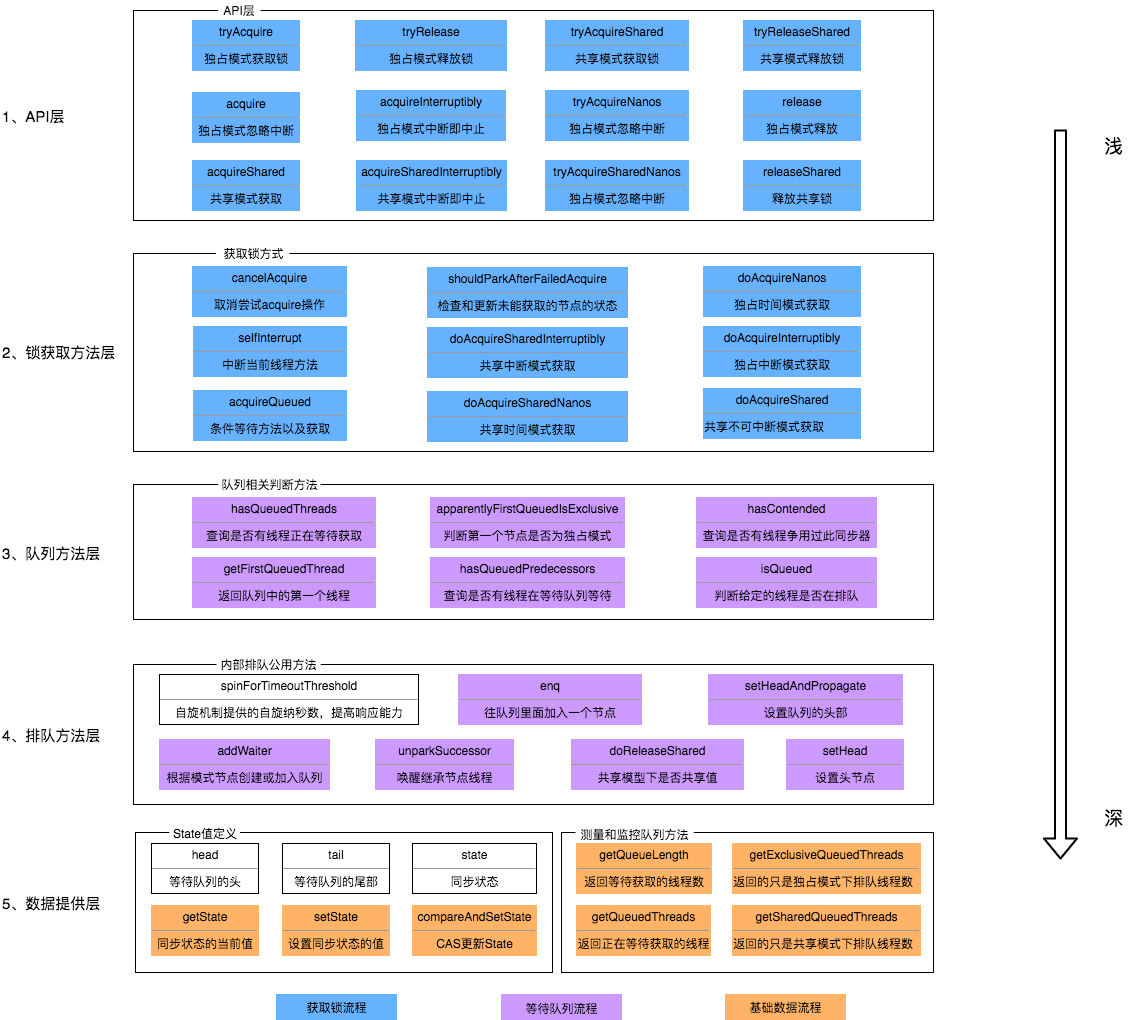
有四个protected修饰的重写方法:
tryAcquire
tryRelease
tryAcquireShared
tryReleaseShared
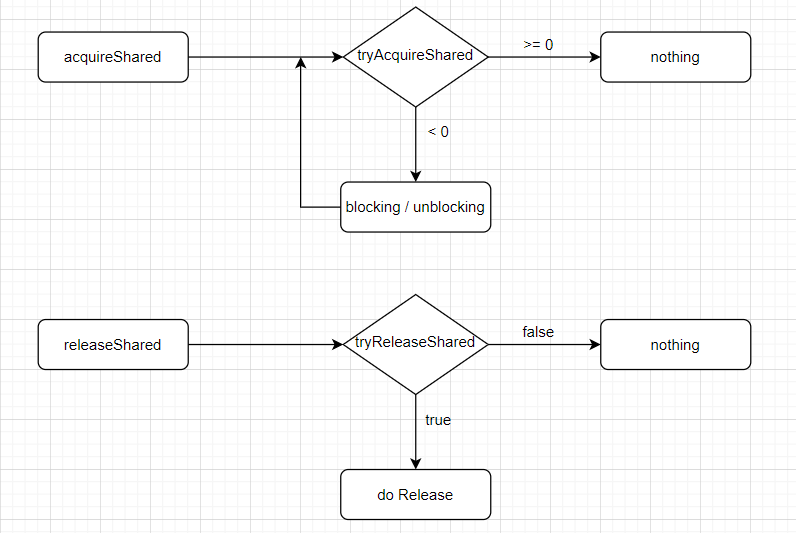
AQS的releaseShared会调用tryReleaseShared,若返回true,就释放阻塞队列中所有的阻塞线程。
AQS的acquireShared、acquireSharedInterruptibly等方法会调用tryAcquireShared,若返回值小于0,就阻塞线程,放入阻塞队列中。
acquire这类方法可以理解为获取共享资源的方法,而state就是用来表示共享资源的,可以用state代表共享资源数量。